
How to Improve Cash Flow in Small Business in India

To improve cash flow in a small business, make money arrive sooner and leave later: invoice the day work is done, take an advance, set short and written payment terms, follow up on a schedule, and plan GST, salaries and supplier dues against a weekly cash view. Profit on paper does not pay salaries; cash in the bank does.
I look after finance at Anant AGI, and the pattern I see in small Indian businesses is rarely a lack of sales. The sale is made, the work is done, and the money sits in someone else's account for 60 or 90 days while your GST, rent and salaries fall due on fixed dates. This guide is general information, not tax or legal advice, so check anything specific with your CA.
Why does a profitable business still run out of cash?
Because profit and cash are measured differently. When you raise an invoice, your books show revenue. Your bank balance does not change until the customer pays. In between, you have already paid for materials, staff time and often GST on that sale.
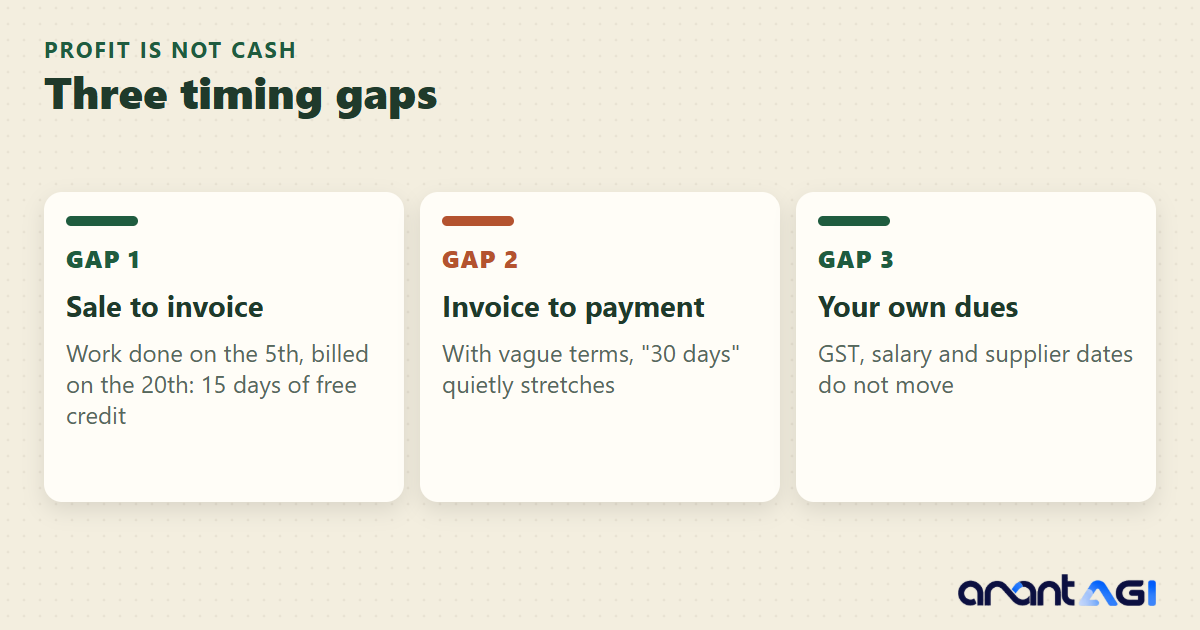
Three timing gaps cause most of the trouble:
- Sale to invoice. Work is finished on the 5th, the invoice goes out on the 20th. That is 15 days of free credit you gave without agreeing to it.
- Invoice to payment. Payment terms are vague or unwritten, so "30 days" quietly becomes whatever the customer's accounts team feels like.
- Your own dues. GST, salaries and supplier payments have fixed dates that do not move because a customer is late.
If you do not know your numbers for these three gaps, start there. Write down, for your last 10 invoices, the date of work done, the date the invoice was sent and the date the money arrived. The average of the last column is your real collection time, whatever your terms say.
How do I get paid faster on the money customers owe me?
Receivables are usually the biggest lever. These steps cost almost nothing and work for most service and trading businesses.
| Step | What to do | Why it helps |
|---|---|---|
| Invoice on the day of delivery | Send the invoice the same day the work is done or goods are dispatched | Your payment clock starts on the earliest possible date |
| Write the terms on the quotation and invoice | State the due date, not just "net 30" | A date is easier to chase than a vague term |
| Ask for an advance or milestone payments | For larger jobs, take a part payment on order and the rest in stages | The customer funds part of your costs instead of you |
| Send the right invoice first time | Correct name, GSTIN, amount and PO number | A wrong invoice gives the customer a reason to hold payment (see what a GST invoice must contain) |
| Follow up on a schedule | Reminder before the due date, on the due date, then firmer notes | Written, timed follow-up beats waiting and hoping (see how to follow up on invoice payment) |
| Make paying easy | Put bank details or a UPI payment link on the invoice | Customers pay faster when it takes one step |
None of this is clever. The businesses that collect well are not tougher, they are just more regular: the same reminders go out every time, on the same days, to every customer.
If you are already chasing overdue money, the fuller process is in how to recover overdue invoices in India, and there is wording you can copy in payment reminder message examples.
Should I offer a discount for early payment?
Sometimes, but do the arithmetic first. A discount for payment within 10 days costs you a fixed percentage of the invoice. Compare that with what it costs you to wait: interest on an overdraft or cash credit line, or the sales you cannot take because your cash is tied up. If you borrow at a modest rate, a large early-payment discount is usually more expensive than the loan. If you are not borrowing and simply stuck without cash, a small discount for a few large, slow payers can still be worth it.
A safer first move than a discount is a clear advance on new orders. Customers who will not pay an advance are often also the customers who pay late, which tells you something about the relationship.
How does GST timing affect my cash flow?
GST is a cash-flow trap because the tax is calculated on what you invoiced, not on what you collected. If you raise an invoice in October and the customer pays in January, you still report that sale in your October return. In general terms, tax liability arises when you issue the invoice or receive payment, whichever is earlier. I did not verify the exact time-of-supply rule from the Act text for this post, so ask your CA how it applies to your kind of supply.
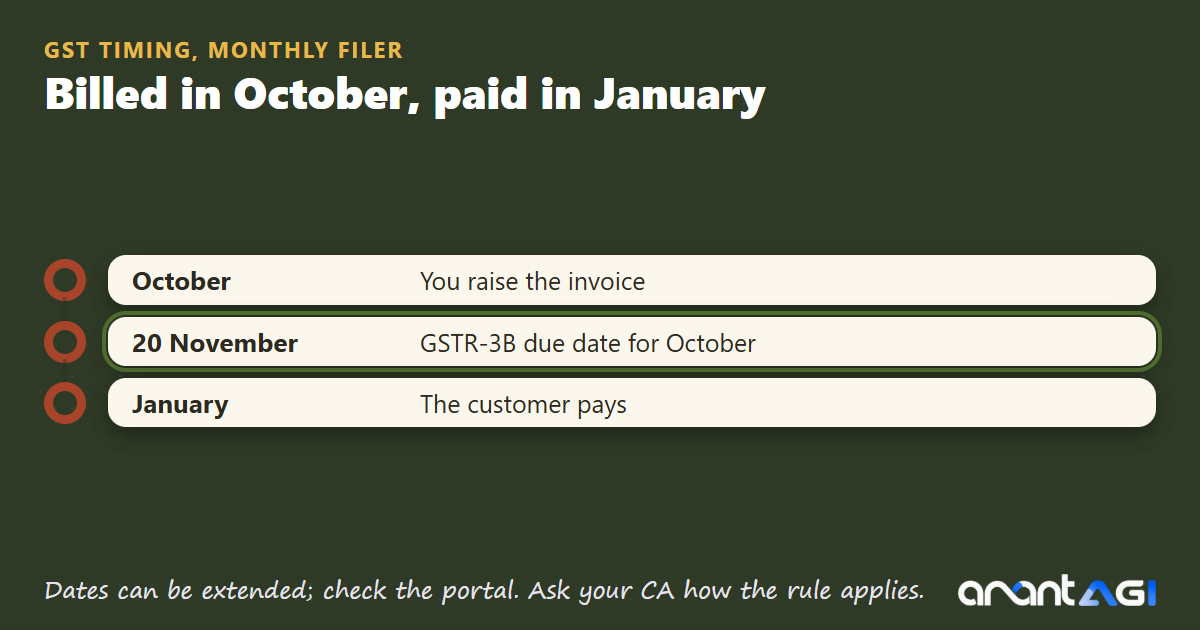
What I did confirm on the official GST portal: for monthly filers, the due date for Form GSTR-3B is the 20th day of the month following the tax period, and quarterly filers have a due date of the 22nd or 24th depending on their state or union territory. The same guide explains that interest on late payment is calculated under the first proviso to Section 50 of the CGST Act. Due dates are sometimes extended by notification, so check the portal each month rather than relying on memory.
What this means in practice:
- Know the GST cash you will owe before the 20th. Your invoices for the month decide it, not your collections.
- Do not spend GST money. The tax you charge customers is not your margin. Keep it visible in your cash plan, even if you do not keep it in a separate account.
- Do not delay invoices to push GST out. The sale has happened, and the timing-of-supply rules are your CA's area. The right fix is to collect sooner, not to invoice later.
- Check input credit paperwork early. Credit you cannot claim because a supplier's paperwork is wrong is cash you have paid out for nothing.
What about the 45-day MSME payment rule?
If you sell to businesses and you are a registered micro or small enterprise, two rules may work in your favour. The MSMED Act sets a time limit for buyers to pay, with a maximum of 45 days when there is a written agreement, and section 43B(h) of the Income-tax Act defers a buyer's tax deduction for overdue amounts owed to micro and small enterprises until they are actually paid. Secondary sources agree on this, but details such as who counts as an eligible supplier, whether a Udyam registration is required, and how traders are treated differ between commentaries. I did not read the Act or the official page directly for this post, so confirm the current wording with your CA before you quote it to a customer.
If you want the longer explanation and the complaint route, see how to recover overdue invoices in India. The practical point is this: put the payment term in writing, keep proof of delivery, and do not wait six months to raise the issue.
Can I turn unpaid invoices into cash before the customer pays?
For some businesses, yes. India has an RBI-regulated platform called TReDS (Trade Receivables Discounting System) where MSMEs can sell invoices issued to larger buyers to financiers and receive money earlier. In a speech published in the RBI Bulletin of 24 December 2024, an RBI official urged MSMEs to "prioritise the use of TReDS", saying it gives access to working capital, and advised MSMEs to ask their buyers to join it.
It is not for everyone. It works best when your buyers are larger companies or government bodies who already participate, and financiers charge for the money they advance. Treat it as one option to discuss with your bank or CA, not as a default.
What should my weekly cash routine look like?
Most small business owners check their bank balance. That tells you where you are, not where you are going. A 20-minute weekly routine is enough:
- List money expected in the next 4 weeks, invoice by invoice, using the due date and your customer's real habit, not the contract date.
- List fixed money going out in the same 4 weeks: salaries, rent, GST, loan EMIs, supplier dues.
- Spot the week where the balance goes thin. That is the week to chase, ask for an advance, or delay a discretionary purchase.
- Call the three biggest overdue customers this week, not all of them. Concentrate on the amounts that matter.
- Look at the invoices you have not sent yet. Delivered work with no invoice is the cheapest cash to recover.
Keep it on one page. A forecast you will actually update beats a detailed model you abandon in a month.
How Anant AGI helps
Anant AGI is a Business OS for small businesses. For this topic, the part that exists today is a pending-work view that lists accepted quotations with no invoice yet, draft invoices and overdue invoices in one place, with actions to create or send an invoice, so that "delivered but not billed" work does not slip through. Payment reminders drafted from the real invoice record are described in what a Business OS is and how the approval step works for AI agents. Cash forecasting and automated bank matching are still to do and are not available. If you want to try it, see early access.
FAQ
What is the fastest way to improve cash flow in a small business?
Send invoices the same day the work is done, and follow up on every invoice on a fixed schedule. These two habits shorten your collection time without needing any new money or tools.
How much cash should a small business keep in reserve?
There is no single correct number, but many advisers suggest enough to cover a few weeks to a few months of fixed costs such as salaries, rent and GST. Your own reserve should reflect how late your slowest customers actually pay, so look at your last 10 invoices first.
Does GST have to be paid even if my customer has not paid me?
Generally yes, because GST is reported for the month in which you issued the invoice, not the month you were paid. Confirm how this applies to your supplies with your CA.
Is a cash credit or overdraft the right fix for late payments?
It can bridge a gap, but it costs interest and does not fix the cause. Use it for timing gaps you can see ending, and work on collection and advances so you do not depend on it every month.
Can I charge interest to customers who pay late?
You can if your quotation, contract or invoice terms say so upfront, and charging without prior agreement often damages the relationship. If you are a registered micro or small enterprise, the MSMED Act has its own provisions on delayed payment, so check with your CA.
Sources
- GST Portal, Form GSTR-3B user guide (due dates, interest): tutorial.gst.gov.in
- Reserve Bank of India, RBI Bulletin, "MSMEs - Bridging the Credit Gap through Improving Confidence in Lending", 24 December 2024: rbi.org.in