
What Is Outdoor Advertising? Types, Costs and Basics

Outdoor advertising, also called out-of-home (OOH) advertising, is any paid message that people see when they are outside their homes: on billboards, bus shelters, buses, walls, airports and similar public places. A business rents the space for a fixed period, puts its creative on it, and pays by site, size and duration.
What counts as outdoor advertising?
The simplest test is location. If the ad reaches you on the road, at a station, in a mall or near a shop, and you did not choose to switch it on, it is outdoor advertising. Shopify's guide describes it as advertising that reaches consumers when they are outside their homes, and notes that OOH is the same thing under another name.
In India you will hear several local words for the same idea: hoarding, unipole, gantry, wall paint, kiosk, bus-back, auto-back. They are all formats within OOH. The word "hoarding" usually means a large board on a frame or a building. It is not a separate industry.
Two things sit around the edges:
- Digital OOH (DOOH) is the same placement idea, but the face is a screen that can rotate messages instead of a printed sheet. It is a subset of OOH, not a separate category.
- Indoor and place-based media such as mall screens, cinema ads or in-store displays are counted as OOH by some bodies and left out by others. Always ask a seller what their number includes.
What are the main types of outdoor advertising?
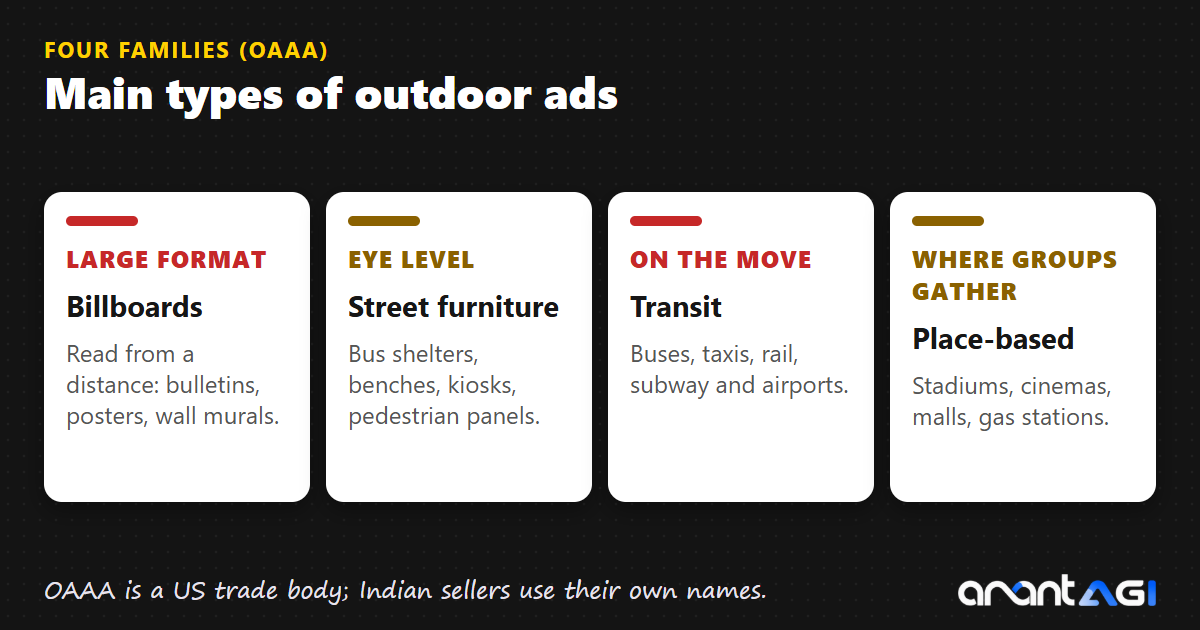
The US trade body OAAA groups formats into four families on its media formats page. Indian sellers use their own names, but the families map across well enough to plan with.
| Family | What it is (OAAA wording, shortened) | Examples listed by OAAA |
|---|---|---|
| Billboards | Standardised large-format displays meant to be read from a distance, generally more than 50 feet | Bulletins, posters, junior posters, wall murals, digital bulletins |
| Street furniture | Displays near pedestrians for eye-level viewing, or at the curb to reach traffic; many provide a public amenity | Bus shelters, bus benches, kiosks, newsstands, pedestrian panels |
| Transit | Displays on moving vehicles or in the common areas of stations, terminals and airports | Buses, wrapped buses, taxis, truckside displays, rail and subway, airports |
| Place-based | Formats located where particular groups gather | Stadiums, cinemas, malls, gas stations, in-store |
A billboard is the one most people picture: one big face on a road, seen for a few seconds by people passing. Street furniture works at walking speed, so it can carry more words and be seen more than once by the same person. Transit moves through the city and covers many areas with one buy.
A later post in this series will go through each family in more detail, with notes on what suits a local shop and what suits a state-wide campaign.
How much does outdoor advertising cost?
There is no honest single price. We are not quoting rupee figures here, because rates for OOH differ widely from city to city and site to site, and we have not opened a published rate card we could stand behind. Ask each media owner for a written quote for your exact site and dates.
What the cost is made of is more reliable than any number. These are the usual drivers:
- Location. A face on a busy junction costs more than the same size on a quiet road. Seen-by counts, direction of travel and what is around the site all matter.
- Size and format. Larger faces, illuminated faces and digital screens cost more to run than small or unlit ones.
- Duration. Most buys are for a fixed period, so a longer booking means more rent. Ask whether a longer term earns a lower monthly rate.
- Creative production. Printing, flex or vinyl, and installation are usually separate lines from site rent. Ask who pays when the creative must be replaced.
- Permission and fees. In India the site must be permitted by the local authority (see the next section). Ask whether the quoted price includes municipal fees and who is responsible for renewals.
- Share of the screen or the loop. On digital faces you often buy a slot in a rotating loop, so ask how many advertisers share the screen and how long your slot runs.
For scale, the OAAA reported that US OOH revenue surpassed $9.1 billion in 2024, up 4.5% on the year, with digital OOH at 34% of spend. That is a United States industry figure from a trade body, not an Indian market number.
Who gives permission for a hoarding in India?
In India, outdoor advertising is regulated mainly by city and state rules, not by one national OOH law. This is why the answer to "do I need permission?" is always "from whom, in which city?".
Observer Research Foundation's article on advertisement hoardings in Indian cities describes the general picture. Urban local bodies such as municipal corporations regulate hoardings under municipal statutes, and many cities also have a separate outdoor advertisement policy. It gives Mumbai as an example, where the law says a sky sign needs the written permission of the municipal commissioner. It says an application typically needs a site plan, a design verified by a structural engineer, and a no-objection certificate from the traffic police. It also stresses safety and unauthorised hoardings as the main problems, and cites a 2018 incident in Pune where a collapsed metal frame killed four people.
What we have not done is check each city's current bye-laws, so do not treat the list above as a checklist for your city. Before you book or erect anything:
- Ask the media owner for a copy of the current permission for that exact site, with its validity dates.
- Ask who holds the structural stability certificate and when it was last renewed, where your city requires one.
- Check with the local municipal office or an advertising professional in that city for the present rules and fees. They change, and they differ.
An unpermitted face can be removed, and your creative with it. The permission is part of what you are paying for.
How do you plan a first outdoor campaign?
A short checklist for a first-time buyer:
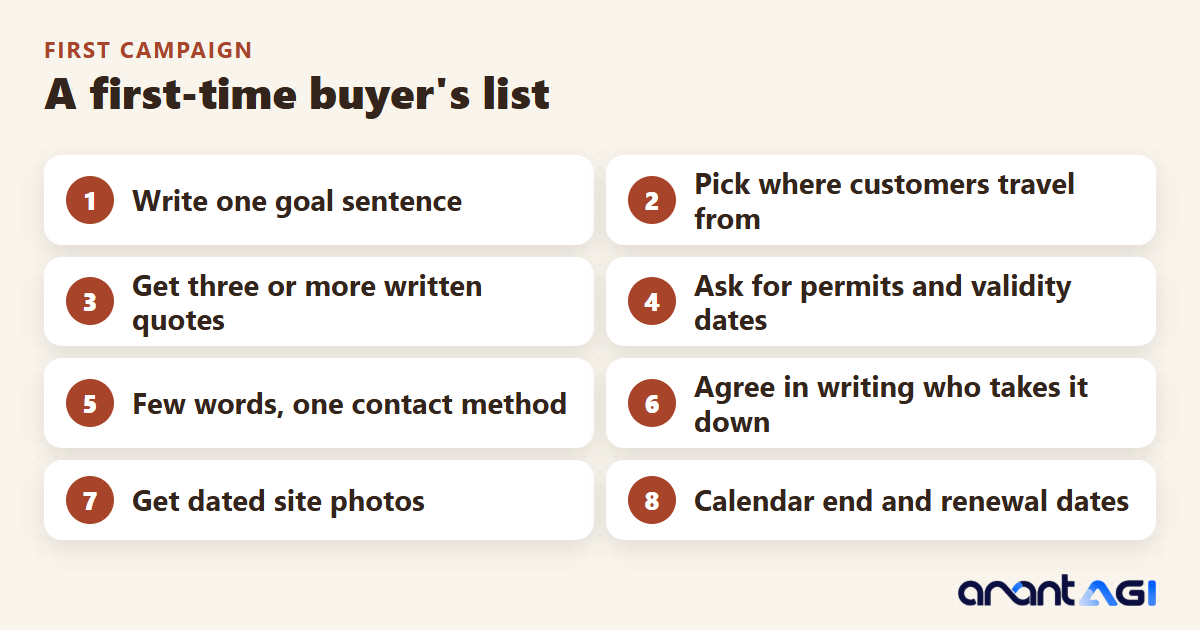
- [ ] Write one sentence on what you want people to do after they see it (visit a shop, call, scan a code).
- [ ] Choose the area from where your customers actually travel, not from where you live.
- [ ] Ask for at least three written quotes, each showing site, size, dates, rent, printing and installation separately.
- [ ] Ask for the permission details and the validity dates for each site.
- [ ] Keep the message to a few words and a single contact method, because many people see an outdoor face for only a few seconds.
- [ ] Agree in writing who takes down the creative at the end of the term, and by when.
- [ ] Ask for dated photographs of the site once the creative is up, and again before the term ends.
- [ ] Put the end date and renewal date in a calendar the day you sign.
Measurement is the hard part of OOH. A printed face does not report who looked at it. Plan a simple way to ask new customers where they heard of you, or use a dedicated phone number or QR code per site, and compare after the campaign.
What do outdoor advertising companies need to run?
If you sell outdoor space rather than buy it, the work is different. You hold an inventory of sites, each with an owner or landlord, a permission, a rent, a status (free, booked, expiring) and a creative to put up and take down. Money leaks when a booking runs past its end date without an invoice, when a permission lapses, or when a landlord's rent is paid late. It is the same pattern we describe for equipment companies in how equipment companies quietly lose money on AMC contracts: the dates and the bills live in different places, so something is always missed.
How Anant AGI helps
Anant AGI is a business system that keeps quotations, invoices, bookings and follow-ups on one shared database. For an outdoor advertising business today, that means the quotation and invoice side: sending a quotation, seeing accepted quotations that have no invoice yet, and chasing overdue invoices from one screen.
An outdoor-specific module, with a site inventory, permission expiry dates and a campaign calendar, is still to do and is not live. If that is what you need, tell us through early access so we know what to build first. We are not publishing prices.
FAQ
What is the difference between outdoor advertising and OOH?
Nothing material. Outdoor advertising and out-of-home (OOH) advertising are two names for paid ads seen outside the home, and trade bodies mostly use "OOH".
Is a billboard the same as a hoarding?
In everyday Indian usage, yes: both mean a large advertising board on a frame or building. In industry grouping, a billboard is one format within OOH, alongside street furniture, transit and place-based media.
Is outdoor advertising effective for a small local business?
It can be when your customers pass the site, but we cannot give you a result rate. Pick a site on the route your customers actually travel, keep the message short, and track a call number or QR code to see what it brought.
Do I need permission to put up a hoarding in India?
Rules are set mainly by city and state, and in the sources we read, municipal authorities give permission under municipal law. We did not verify each city's current rules, so check with the local municipal office before booking or building.
What is digital outdoor advertising?
Digital OOH uses screens instead of printed faces so the content can change and rotate. According to OAAA, digital accounted for 34% of US OOH ad spend in 2024.