
What Is Proof of Posting in Outdoor Advertising?

Proof of posting is the evidence a media owner gives an advertiser that a contracted outdoor ad was actually put up at the booked site. For a static billboard it is usually a set of dated photos, sometimes with GPS coordinates or a signed form. It shows the ad was installed, not that anyone noticed it.
This post explains what a proof pack contains and how to check one. For the basics of the medium, start with what is outdoor advertising, and for the formats see types of OOH advertising.
What is proof of posting in outdoor advertising?
Out-of-home advertising has a basic trust problem. The advertiser pays for a face on a road, a shelter or a bus, but usually does not live near it and cannot walk past every site to check. The media owner or the installer is the one who knows whether the flex went up on time.
Proof of posting closes that gap. The glossary at Media Ant, an Indian outdoor media marketplace, defines it as evidence provided by an outdoor advertising agency or media vendor to verify that an ad has been placed where it was meant to be. Its examples of that evidence are photographs, GPS coordinates and signed verification forms. Media Ant sells media, so read its page as a trade glossary, not a standard.
In everyday work it is a simple object: one or more photos per site, taken after the creative is installed, sent to the client with the site name, the date and the campaign name. The idea is old and the tools are modest. What matters is that the evidence is specific to the contracted site and date.
How is proof of posting different from proof of performance, proof of play and proof of display?
These four terms overlap, and different sellers use them loosely. The table below is our reading of the sources we opened, not an official standard. Always check how your own contract uses the words.
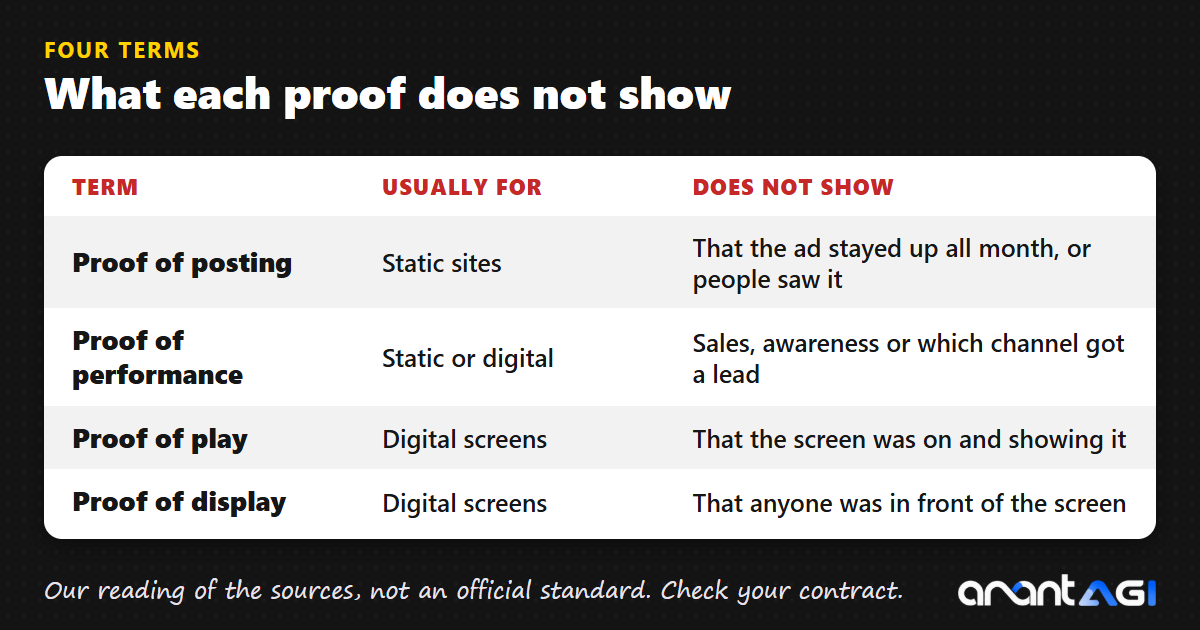
| Term | Usually used for | What the evidence looks like | What it does not show |
|---|---|---|---|
| Proof of posting | Static sites: hoardings, posters, wall paint, bus wraps | Dated photos of the installed ad, sometimes GPS or a signed form | That the ad stayed up all month, or that people saw it |
| Proof of performance | The broad term, for static or digital | A certification that contracted service was delivered, with photos or reports | Sales, awareness or which channel produced a lead |
| Proof of play | Digital screens | A log from the scheduling software showing when a creative was meant to run | That the screen was actually on and showing it |
| Proof of display | Digital screens (sometimes used as a synonym for proof of performance) | Telemetry such as power and display status, ideally checked by a third party | That anyone was in front of the screen |
The OAAA, the US outdoor industry body, defines proof of performance as certification by an OOH company that contracted advertising services have been rendered. Effortless Outdoor Media, a billboard operator, quotes that definition and treats proof of performance as the umbrella document. A digital-OOH research note from BDOOH draws a sharper line for screens: a play log generally measures what was scheduled, and a screen can be scheduled but dark and still log a play. That is why some DOOH writers ask for display-level evidence on top of play logs.
For a hoarding, none of this digital debate applies. Proof of posting, a photo set, is the practical answer.
What goes into a proof of posting pack?
A single blurry photo with no context is weak proof. A usable pack ties each photo to a booked site, a creative and a date. Based on what Effortless Outdoor Media lists for proof of performance, a good pack covers:
- The exact unit or package, with its identifier and location
- The approved creative version
- Start and end dates, plus any agreed posting window
- Visual evidence such as photos, confirmations or reports
- Any exceptions, with the follow-up and how they were resolved
For the photos themselves, the same page and the FotoFetch guide point to a few practical habits. FotoFetch, a photo-service vendor, says media companies usually take average-quality installation photos at the start of a campaign and during rotations, and offers higher-quality photography as an extra. Its own service delivers geotagged, timestamped photos, which is a vendor claim about its product, not an industry rule.
A checklist the media owner can use on every job:
- A wide shot showing the whole board and enough surroundings to identify the place.
- A closer shot where the message, phone number and dates can be read.
- The site name or number written on the report next to each photo.
- The date and time of the photo, and the location where it was taken.
- The campaign or client name and the creative version installed.
- A note on anything unusual: damage, a blocked view, a lighting fault, a late install.
How does an advertiser check a proof of posting?
Receiving a photo is not the same as verifying it. A short routine catches most problems. This follows the checks that Effortless Outdoor Media suggests for billboards:
| Check | What to look for | Red flag |
|---|---|---|
| Right face | The photo matches the booked unit, not just a nearby location | A different structure or a different face of a double-sided board |
| Right artwork | Address, offer, phone number and dates match the approved file | An old creative, a typo, a cropped message |
| Right date | The evidence shows when it was captured and what period it covers | No date, or a date before the campaign start |
| Enough context | The photo shows the placement, not only a crop of the flex | A tight shot that could be any board |
| Exceptions | Problems are logged with a unit, a condition and an owner | A clean report for every site on a stormy week |
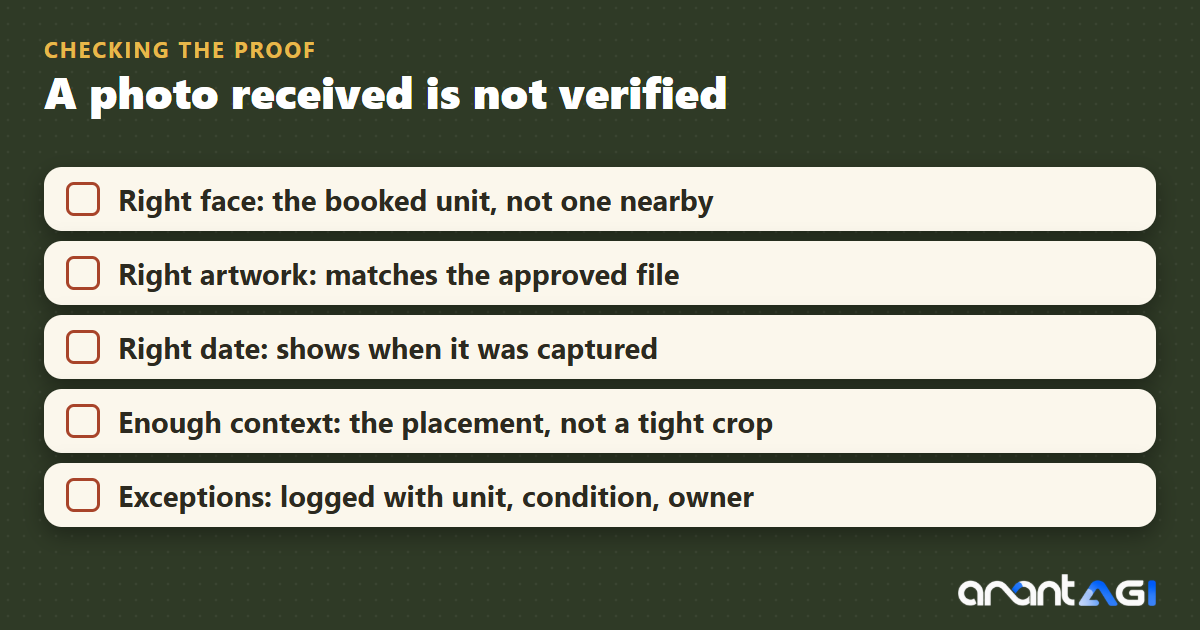
If something is off, log it against the site and ask for a corrected photo or a fix. Keep the requests and the replies in one place so a dispute later has a trail.
What are the limits of proof of posting?
It is worth being honest with clients about what the document can and cannot say.
- One moment, not the whole flight. A photo of a printed board on one date is evidence of how it looked at that moment, not of continuous display across the campaign. If the contract runs for weeks, ask for photos again during the run, not only at the start.
- Delivery, not results. Proof of posting does not show sales, awareness or which channel produced a lead. Track results separately, for example with a dedicated phone number on the board.
- Format matters. Digital screens need play and display evidence, and aggregated digital reports may not confirm what happened at the level of one screen.
- Faked or reused photos are possible. An old photo can be sent for a new campaign. Dates, location details and a second look from the client reduce the risk but do not remove it.
- The contract decides. What counts as proof, how fast it must arrive and what happens when a site fails are contract terms. If that is not written down, it is not a right.
How can a small outdoor business handle proof of posting without chaos?
Most small media owners and installers run this on phones and chat: the field person takes photos, sends them in a group, someone saves them, someone else builds the report, and the invoice waits until the report is done. The weak points are predictable: photos lost in a chat, no site name on the picture, a report built from memory, and an invoice that goes out late because nobody knows which sites are finished.
A sensible routine needs no special software:
- Give every site a short code and put it on the booking sheet.
- Tell the field person exactly which photos are needed before they leave.
- Save each photo in a folder named by campaign and site code the same day.
- Review the set before sending, checking the face, artwork and date.
- Send one report per campaign, then raise the invoice the same day.
- Chase any unpaid invoice from the same record. The AMC contracts and money leaks post shows the same pattern for service contracts: money leaks where the work record and the billing record are separate.
If you want to move the field step into chat, our post on WhatsApp business automation software covers what such tools do and where their limits are.
How Anant AGI helps
Anant AGI is a business system that keeps quotations, invoices and follow-ups on one shared database. For an outdoor advertising business today, that covers the money side: sending quotations, seeing accepted quotations that have no invoice yet, and chasing overdue invoices.
Proof of posting itself is planned, not built. The design we have written down is a WhatsApp task for the field person that asks for the required photos and a location, records the server's receive time, lets the owner approve or reject, and then builds a client report. None of that is live: the WhatsApp integration, the proof record and the report are all still to do. We also know that WhatsApp strips location data from normal photos, so any real version would ask for location separately, and no tool can fully stop a determined person sending a stale photo. If this is the feature you need, tell us through early access so we know what to build first. We are not publishing prices.
FAQ
What is proof of posting in simple words?
It is the evidence, usually dated photos, that a media owner gives an advertiser to show an outdoor ad was put up at the booked site. It confirms installation, not results.
Is proof of posting the same as proof of performance?
They are close and often used interchangeably, but sources use them loosely. Proof of performance is the broader term, defined by the OAAA as certification that contracted advertising services have been rendered. Proof of posting usually means the photo evidence for static sites.
What is proof of play in digital outdoor advertising?
It is a log from the scheduling software showing when a creative was meant to play on a screen. A research note from BDOOH points out that a log shows what was scheduled, not necessarily that the screen was on, so display-level evidence is sometimes asked for as well.
Does proof of posting show that people saw the ad?
No. It shows the ad was installed at a place and time, not that anyone noticed it or acted on it. Measure response separately, for example with a unique phone number or offer code on the ad.
Who pays for proof of posting photos?
We did not find a standard rule, so check your contract or rate card. Ask the media owner before booking whether the photos are included, how many per site, and how soon they arrive.
Sources
- Media Ant: What is proof of posting (vendor glossary)
- BDOOH: Proof of play, scheduling versus display
- Effortless Outdoor Media: Billboard proof of performance (billboard operator)
- FotoFetch: How to prove your OOH ads are working (photo-service vendor)