
How to Recover Overdue Invoices in India: A Guide
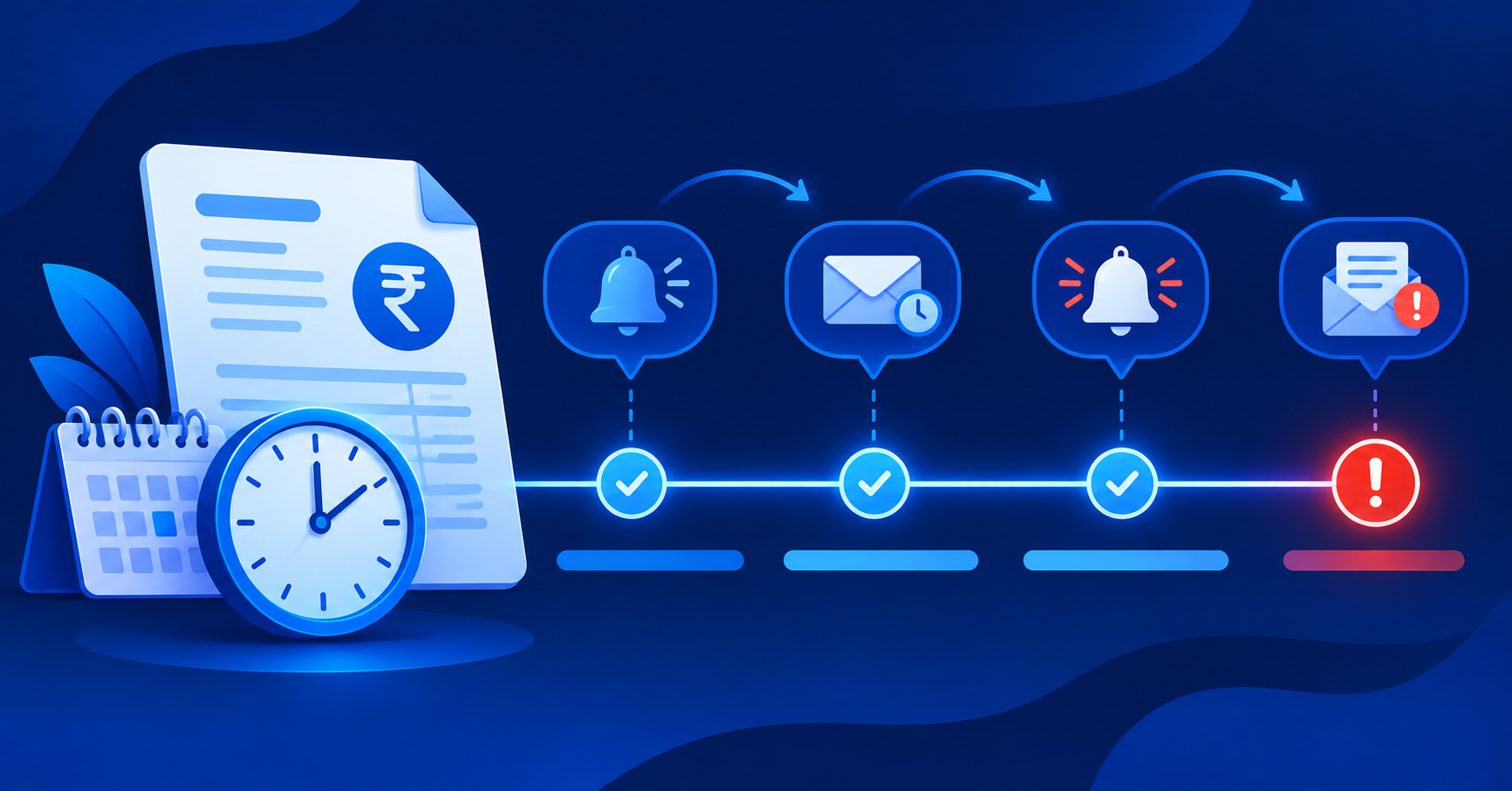
To recover an overdue invoice, send a polite reminder before the due date, follow up at regular intervals with a firmer tone each time, make the next step clear with a payment link, and escalate formally if needed.
If you are a registered micro or small enterprise, the MSME Act and the Samadhaan complaint route can add interest and a formal process (details below). This guide is general information, not legal or tax advice.
What is the best follow-up schedule for an unpaid invoice?
Sources differ slightly on exact days, so treat these as a guide and adjust to your contract and customer (Zoom, FreshBooks, Agicap).
| When | What to send | Tone |
|---|---|---|
| A few days before the due date | Friendly reminder with invoice number and due date | Warm |
| On the due date | Short note and payment link | Neutral |
| Around 1 to 7 days late | Check if there is a problem; ask for a payment date | Polite |
| Around 14 days late | Mention the payment terms; ask for a firm date | Firmer |
| 30 days late or more | Formal final notice stating next steps | Formal |
What should a payment reminder include?
A good reminder is short and complete:
- [ ] Invoice number in the subject line
- [ ] Invoice date, original due date and amount outstanding
- [ ] Number of days overdue
- [ ] A clear next step, such as a payment link or bank details
- [ ] Late fees or interest, only if your terms say so
- [ ] A named contact person
Start by assuming it is an oversight. Many late payments are, and a friendly start protects the relationship.
Sample WhatsApp-style message
Hi Rahul, a quick reminder that invoice INV-1042 for ₹25,000 was due on 10 November. Could you let me know when we can expect payment? Payment details are attached. Thank you!
Names, number and dates are placeholders.
What if the customer still does not pay?
- Call. A phone call often reveals the real reason: a dispute, a missing purchase order or a cash-flow issue.
- Put it in writing. Send a formal letter or email that records the amount, the days overdue and the date you expect payment.
- Offer a plan if needed. A written instalment plan is better than no payment.
- Escalate. A formal outstanding-payment letter is often the last step before collections or legal action (Stripe).
Does the MSME 45-day payment rule help me?
It can, if you are a micro or small enterprise supplying goods or services. Check these points with your accountant:
- Payment time limit. Under the MSMED Act, the buyer should pay within the agreed period, up to a maximum of 45 days, or within 15 days if there is no written agreement (Busy).
- Interest. Secondary sources say late payment attracts interest at three times the RBI bank rate, compounded monthly. Confirm the current rate on the RBI notification (IIFL).
- Tax pressure on the buyer. Section 43B(h), effective 1 April 2024, defers a buyer's tax deduction for overdue amounts owed to micro and small enterprises until they are paid (Business Standard).
- Complaint route. Complaints go to the state's Micro and Small Enterprise Facilitation Council, filed through the MSME Samadhaan portal, usually needing a valid Udyam Registration (ClearTax).
If you are not an MSE, or the customer is a consumer, these routes may not apply. Ask a CA or lawyer.
How can software help?
Most of the work in recovery is repetition: noticing which invoices are overdue, writing the right message and remembering to follow up — the same kind of repeated work our medical equipment service and event software customers deal with on their own overdue accounts. Anant AGI's Revenue Recovery module is designed for exactly this — it looks for overdue invoices and stale deals and prepares a draft follow-up. By default, a person approves the draft before it is sent; detecting failed online payments is not built yet, since the product has no payment-gateway connection today. This fits the same idea behind the whole product — see what a Business OS actually is for the bigger picture.
FAQ
When should I send the first reminder?
Many guides suggest a friendly note a few days before the due date, then one on the due date.
How many reminders are too many?
There is no fixed number. Increase firmness gradually, and stop to speak by phone if a customer is not responding.
Can I charge interest on late payment?
Only if your contract or applicable law allows it. For registered micro and small enterprises the MSMED Act provides for interest. Check with a CA.
What is the MSME 45-day rule?
A rule that payments to micro and small enterprises must be made within the agreed time, up to 45 days, and that overdue amounts affect the buyer's tax deduction under Section 43B(h).
Is it better to call or message?
Message first so there is a written record, then call if there is no response.
Sources
- Reminder cadence: Zoom, FreshBooks, Agicap
- Outstanding payment letter before collections: Stripe
- Section 43B(h) and the 45-day limit: Busy, Business Standard
- Samadhaan, MSEFC, interest rate: IIFL, ClearTax