
MSME 45 Days Payment Rule Explained for Small Sellers

The MSME 45 days payment rule says a buyer must pay a micro or small enterprise within the period agreed in writing, and never later than 45 days from acceptance. If nothing is agreed in writing, the limit is 15 days. Late payment carries interest, and it also affects the buyer's tax deduction.
I look after finance at Anant AGI. Blogs often say "45 days" and stop there, which is only half the rule. This post separates what I could read in the law from what I could only read in commentary. It is general information, not legal or tax advice. If you are going to act on a specific invoice, ask your CA.
What did I verify from the law, and what could I not open?
Honest status first, because several sources disagree on the 15 versus 45 day detail.
- Verified from a copy of the Act. I opened the WIPO Lex copy of the Micro, Small and Medium Enterprises Development Act, 2006. It is the original 2006 text and the scan has OCR typing errors, so it is not a substitute for the official gazette. I did not verify whether any later amendment changed Sections 15 or 16.
- Read only as a quotation. I could not open the Income-tax Act page on an official site (the Income Tax Department and Union Budget pages returned access errors). The wording of Section 43B(h) below comes from an ITAT Online digest that quotes the clause. That is a secondary source, so the 43B(h) points are not verified from the Act itself.
- Not opened at all. The India Code, MSME ministry, PIB and Samadhaan portal pages did not load, so anything about the complaint process is hedged.
Treat the rest of the post with that in mind, and check the current text with your CA.
What does the rule actually say: 15 days or 45 days?
Both numbers are correct, because they apply to different situations. In the copy of the Act I opened, Section 15 works like this:
- The buyer must pay on or before the date agreed in writing with the supplier.
- If there is no written agreement, payment is due before the "appointed day". Section 2(b) defines that as the day after a 15 day period from the day of acceptance, so in practice the default is 15 days.
- A proviso says that even a written agreement cannot go beyond 45 days from acceptance or deemed acceptance.
So 45 days is a ceiling, not a free allowance. A buyer cannot claim 45 days if the written terms say 30, and a written term of 60 or 90 days cannot override the cap.
| Situation | Payment due | Source |
|---|---|---|
| No written agreement on the payment date | Within 15 days of acceptance (before the appointed day) | MSMED Act Sections 2(b) and 15, WIPO Lex copy |
| Written agreement says 30 days | By the agreed 30 days | Section 15 |
| Written agreement says 60 or 90 days | Capped at 45 days from acceptance or deemed acceptance | Section 15 proviso |
Exact day counting (does the day of delivery count, how weekends fall) is a legal detail I did not verify. Ask your CA if an invoice sits close to the line.
When does the clock start?
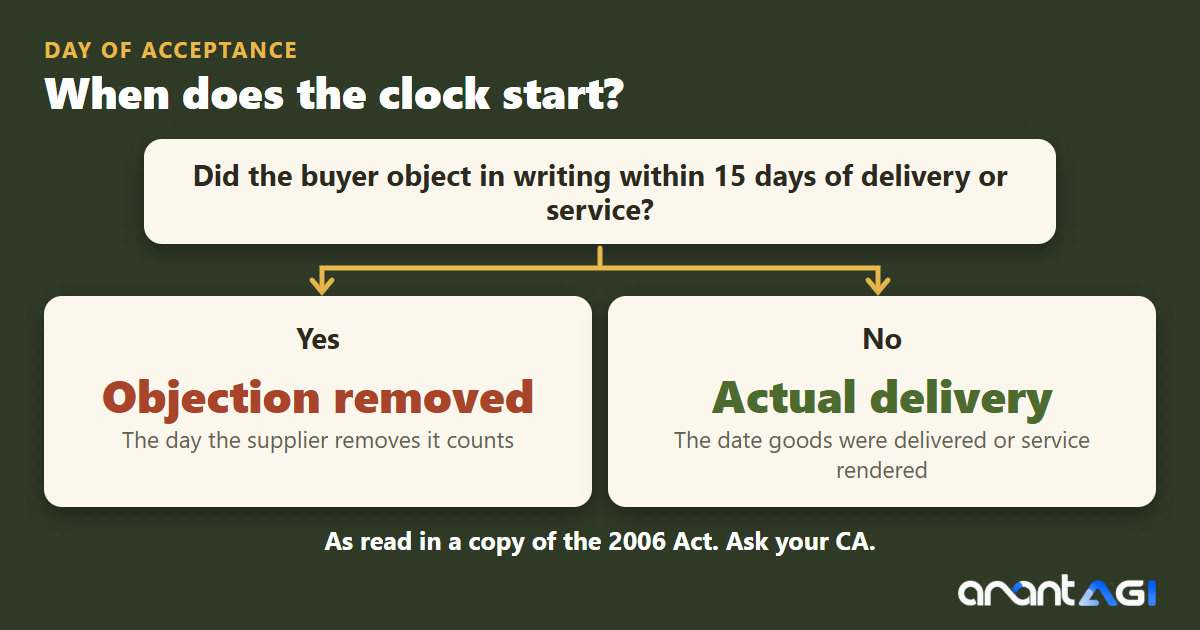
Commentary online disagrees on this: some pages count from the invoice date, some from delivery, some from acceptance. The Act text I opened uses acceptance, and defines it this way in the Explanation to Section 2(b):
- Day of acceptance is the day the goods are actually delivered or the service is actually rendered. If the buyer objects in writing within 15 days, it is the day the supplier removes that objection.
- Deemed acceptance applies when the buyer makes no written objection within 15 days, and the date is then the actual delivery or rendering.
The practical lesson for a small seller is simple: the date you can prove delivery is the date that matters, not the date you got around to billing. A signed challan, a delivery photo, a service completion note or an email confirming receipt all help. The invoice date, by itself, is not the starting point in the text I read.
Here is an illustration with invented dates. Suppose you deliver goods on 1 December and the buyer raises no written objection. There is no written payment agreement. On my reading, payment is due within 15 days of 1 December. If a written agreement says "payment in 60 days", the 45 day cap would apply instead. Apply this to your own contract only with your CA, because this example ignores partial deliveries, objections and disputes.
Who is covered by the MSME 45 days payment rule?
The Act defines a "supplier" as a micro or small enterprise that has filed a memorandum with the authority. The ITAT Online digest points out that the definition covers only micro and small enterprises, so medium enterprises are outside the Section 43B(h) disallowance.
Three points to check before you rely on the rule:
- Registration. The benefit depends on the supplier being registered. Other guides say this means Udyam registration. Keep your certificate number on every quotation and invoice so the buyer cannot say they did not know.
- Traders. Sources disagree. Search results for this topic included commentary saying traders are outside Section 43B(h), while the ITAT Online digest says the MSMED Act now covers traders and professionals but that a 2021 notification limits benefits for retail and wholesale trade to priority sector lending. I could not resolve this from an official page. If you are a reseller or distributor, ask your CA.
- Buyer type. The buyer's size is not the test in the Act definition of "buyer". It is whoever buys goods or receives services from a supplier for consideration. That includes small buyers, not only large companies.
What happens if the buyer pays late?
There are two separate consequences, one for the seller and one for the buyer.
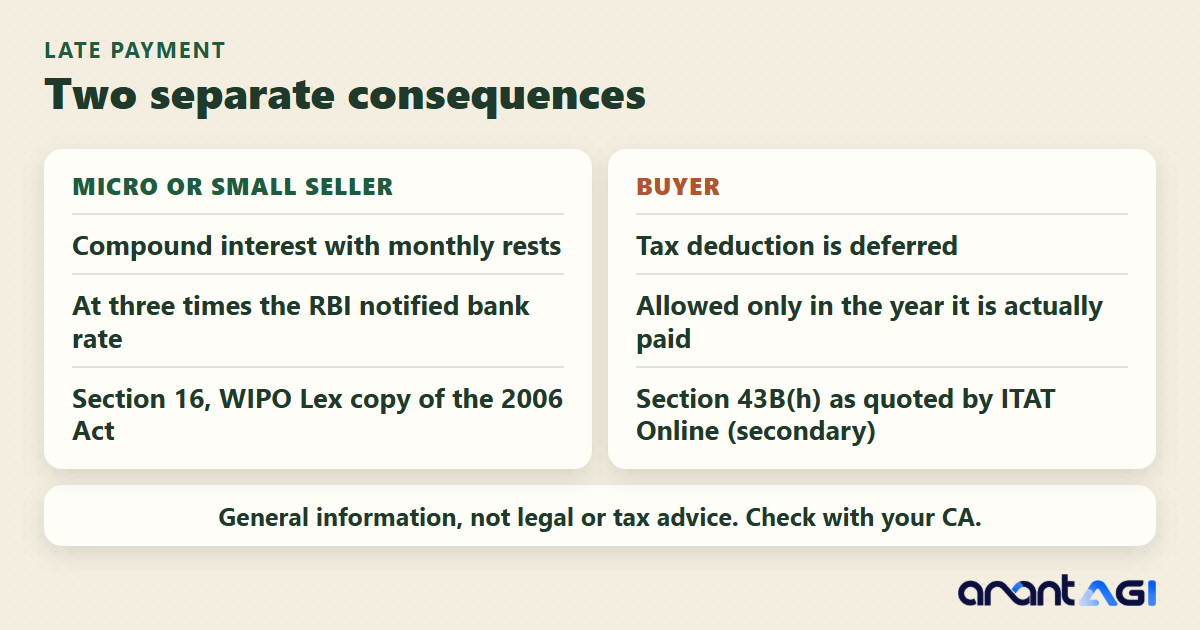
For you as the seller: interest. Section 16 of the Act says that if the buyer does not pay as Section 15 requires, the buyer must pay compound interest with monthly rests, at three times the bank rate notified by the Reserve Bank. It applies despite any contrary agreement, and it runs from the appointed day or from the day after the agreed date. I deliberately give no rupee figure, since the bank rate changes. Check the current notified rate before you quote interest on a bill. Section 17 states that the buyer is liable for the amount with that interest.
For the buyer: a tax deduction delay. Clause (h) of Section 43B, as quoted in the ITAT digest, says any sum payable to a micro or small enterprise beyond the time limit in Section 15 of the MSMED Act is allowed as a deduction only for the previous year in which it is actually paid. The digest says the change applies from assessment year 2024-25 and that the clause is not subject to the usual proviso that lets you claim an expense paid by the return due date. In plain words, a buyer who is late loses the deduction in the year of the expense and gets it only when the payment is made. Section numbers can change when tax laws are re-enacted, so ask your CA which provision applies to your return year.
| Who | What the late payment does | Basis |
|---|---|---|
| Micro or small seller | Can claim compound interest at three times the RBI bank rate | MSMED Act Section 16 (WIPO Lex copy) |
| Buyer | Deduction deferred until the sum is actually paid | Section 43B(h), as quoted by ITAT Online (secondary) |
What should a small seller do differently?
You cannot control when the buyer pays, but you can make the rule usable for you.
- [ ] Hold a current Udyam registration and print the number on quotations and invoices.
- [ ] Put the payment date in writing on the quotation, order confirmation and invoice, and keep it at 45 days or less. Anything longer is capped anyway.
- [ ] Record the delivery or completion date and keep proof of it.
- [ ] If a buyer objects to the goods, make them do it in writing, and note the date the objection was resolved.
- [ ] Diarise the due date and send a reminder before it. See how to follow up an invoice payment for a schedule and payment reminder message examples for wording.
- [ ] Before you charge interest, check the current RBI bank rate and ask your CA about the right way to bill it.
If an invoice is already overdue, how to recover overdue invoices in India covers escalation. For the part that comes before the due date, see how to collect payment from a customer.
What should a small buyer check?
If you buy from small suppliers, the rule works against you when you pay late. A short checklist:
- [ ] Ask each supplier whether they are a micro or small enterprise and keep a copy of their registration.
- [ ] Mark the acceptance date on every bill, not just the bill date.
- [ ] Pay within the written term, or within 15 days if nothing is written, and never later than 45 days.
- [ ] Before 31 March, ask your CA to list unpaid amounts owed to micro and small suppliers, since that is where the tax effect shows up.
How Anant AGI helps
Anant AGI is a Business OS for small businesses. For the seller side of this rule, what exists today is a pending-work view that lists accepted quotations with no invoice, draft invoices and overdue invoices in one place, with actions to create an invoice, send it, copy the link, download it and mark it as sent. That helps you bill promptly after delivery. A tracker for bills you owe to suppliers, and automatic alerts tied to the 15 and 45 day limits, are still to do and are not available today. If you want to try it, see early access.
FAQ
Is the MSME payment limit 15 days or 45 days?
Both. In the Act text I read, payment is due within 15 days of acceptance if nothing is agreed in writing, and a written agreement can extend that, but never beyond 45 days from acceptance or deemed acceptance.
Does the 45 day rule apply from the invoice date?
In the Act text I opened, the period runs from the day of acceptance or deemed acceptance of the goods or services, not from the invoice date. Several online guides say otherwise, so check with your CA for your contract.
Is a medium enterprise covered by Section 43B(h)?
No, according to the ITAT Online digest, because the Act's definition of supplier covers only micro and small enterprises. I could not confirm this from the Income-tax Act page itself.
What interest can I claim on a late MSME payment?
Section 16 of the MSMED Act, in the copy I opened, provides compound interest with monthly rests at three times the bank rate notified by the Reserve Bank. Check the current rate and confirm the billing method with your CA.
Do I have to be registered to use the rule?
The Act defines a supplier as a micro or small enterprise that has filed a memorandum with the authority, and other guides describe this as Udyam registration. Confirm your registration status before you invoice with interest.
Sources
- MSMED Act, 2006 text (Sections 2, 15, 16, 17), WIPO Lex copy with scan errors: wipo.int
- Section 43B(h) wording and effective year, secondary digest: ITAT Online, 43B(h) explained briefly
Not verified: the Income Tax Department, India Code, MSME ministry and Samadhaan pages could not be opened, so the Section 43B(h) wording was not checked against the Act itself. Check it with your CA before acting.