
Payment Reminder Message Examples You Can Actually Use

A good payment reminder message states the invoice number, the amount and the due date, and ends with a direct question - not a vague "just checking in." The wording should get more specific as the invoice ages, not angrier.
Below are message examples for each stage, written for WhatsApp or email, that you can adapt directly.
Before the due date (friendly)
Hi [Name], just a quick reminder that invoice #[number] for ₹[amount] is due on [date]. Let us know if you need anything from our side to process it.
This one should feel like a courtesy, not a chase. Send it 3-5 days before the due date.
On the due date (neutral)
Hi [Name], invoice #[number] for ₹[amount] is due today. Could you confirm when we can expect payment?
No apology, no pressure - just a clear statement of fact and a direct question.
A few days overdue (firmer, still polite)
Hi [Name], invoice #[number] for ₹[amount] is now [X] days overdue. Could you share an update on when payment will be made? Happy to help with anything on our end that's holding it up.
The offer to help isn't just politeness - it genuinely surfaces blockers (a missing PO number, a wrong GST field) that are often the real reason for delay.
Two weeks overdue (direct)
Hi [Name], invoice #[number] for ₹[amount] is now 2 weeks overdue. Please confirm a payment date by [date]. If there's an issue with the invoice or the order, let us know so we can resolve it.
This message names a deadline for the response, not just the payment - "confirm a date by X" gets a faster reply than "please pay soon."
30+ days overdue (escalation)
Hi [Name], invoice #[number] for ₹[amount] has been outstanding for over a month. We need to resolve this - please call us at [number] or confirm a payment date today so we can avoid taking further steps.
At this stage, a phone call alongside the message usually works better than text alone. See how to follow up on invoice payment for the full schedule these messages fit into.
What makes these work?
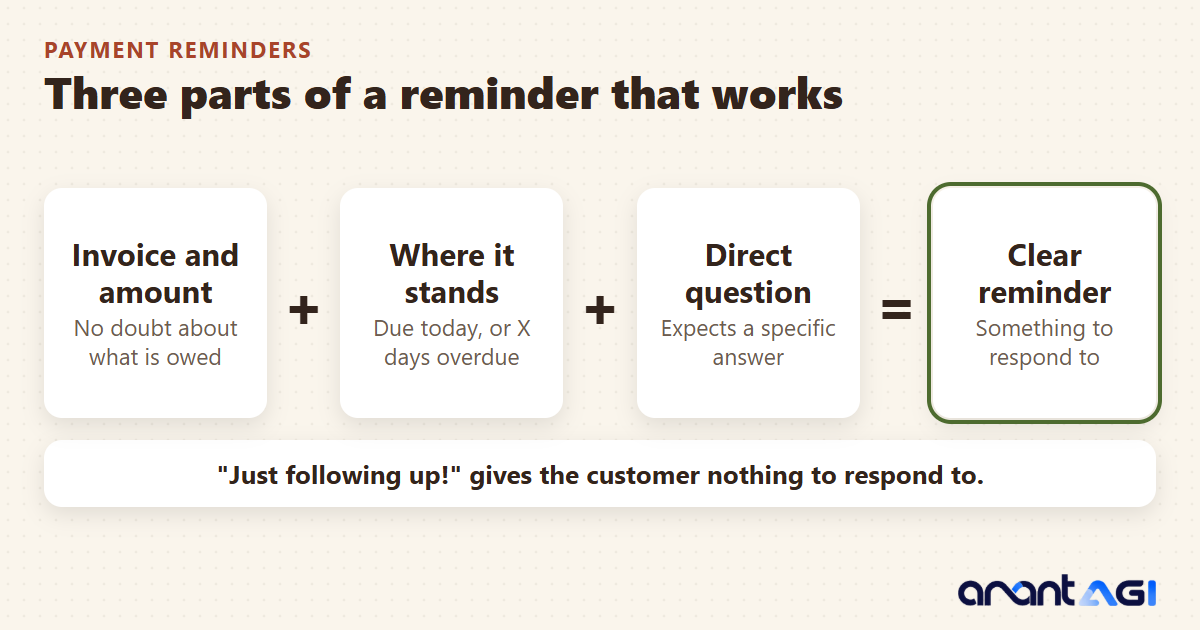
Each message has three fixed parts: the invoice number and amount (so there's no ambiguity about what's owed), a statement of where things stand (due today, X days overdue), and a direct question that expects a specific answer. Messages that skip the direct question - "hope you're doing well, just following up!" - get ignored far more often, because there's nothing for the recipient to actually respond to.
Should the tone ever become angry?
No. Anger in a payment reminder usually backfires - it gives the customer a reason to feel attacked rather than simply reminded, and makes them less likely to engage constructively. The firmness should come from specificity (the exact amount, the exact number of days overdue, a named deadline) rather than from tone. If a customer genuinely isn't going to pay, an angry message doesn't change that outcome - it just burns the relationship on the way to the same result.
Should the message change for a repeat customer vs a one-time buyer?
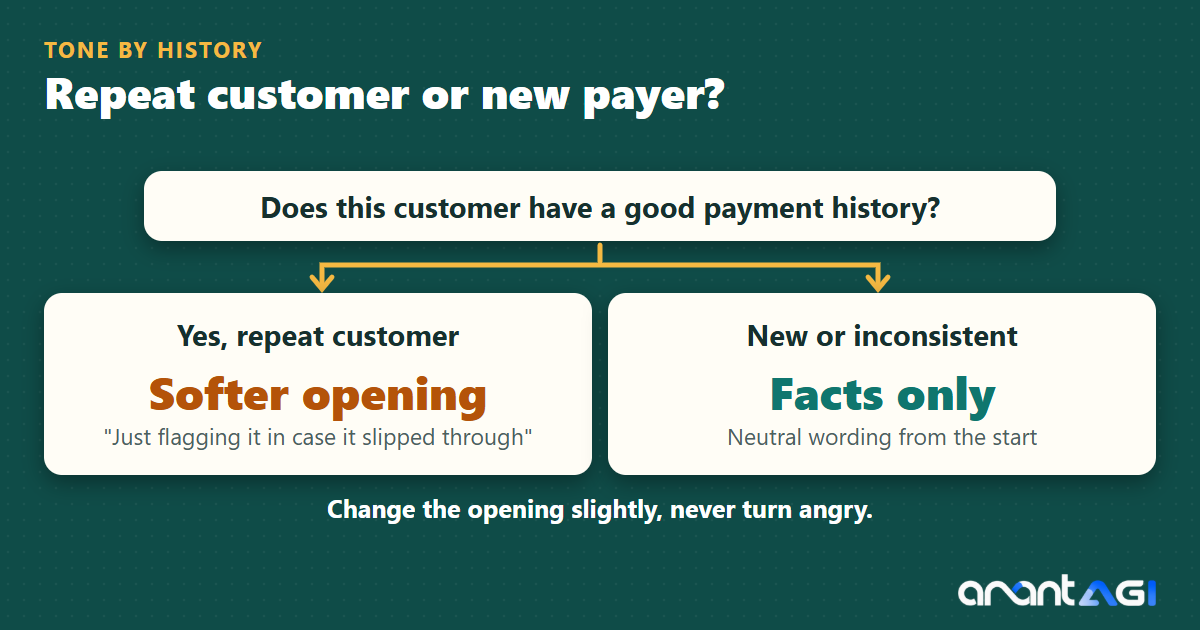
Yes, slightly. For a repeat customer with a good payment history, a softer opening ("I know you're usually prompt on these, just flagging it in case it slipped through") respects the relationship. For a new or inconsistent payer, stick to the neutral, fact-only wording from the start - there's no track record yet to soften the tone with, and treating every late payment identically regardless of history actually reads as more professional, not less.
How Anant AGI helps
Anant AGI's Business OS can draft these messages from the real invoice record automatically, with the amount and due date filled in correctly rather than typed from memory - see what an AI agent for a small business actually does for how the draft-and-approve step works before anything is sent.
FAQ
Should I use WhatsApp or email for payment reminders?
Whichever the customer actually responds to fastest - for many small businesses in India, that's WhatsApp, but check your own customers' habits rather than assuming.
Can I automate these messages?
The early-stage ones (before due, on due date) are good candidates for automation since the wording doesn't change. Later-stage messages benefit from a human glance before sending.
Is it rude to ask for a specific payment date?
No - it's the opposite. A vague "please pay soon" is actually harder for the recipient to act on than a specific question that expects a specific answer.
Should I mention late fees in the reminder?
Only if your invoice or contract already stated them upfront. Introducing a late fee as a surprise mid-chase damages trust more than it recovers in fees.
What if the customer doesn't respond to any of these?
Move to a phone call, and if that also fails, treat it as a collections situation - see the fuller recovery process in how to recover overdue invoices in India.
Sources
- Square, examples of how to write a payment reminder email to a client: squareup.com
- GoCardless, how to write a payment reminder email: gocardless.com