
What Should Be Included in an Event Budget? A Checklist

An event budget should list every cost under clear categories (venue, catering, decor, AV, photography, staffing, permits and licences, transport), add taxes such as GST, record each vendor advance, and keep a contingency line. For every line, track four numbers: estimate, actual, paid and balance.
Most overruns do not come from one big mistake. They come from small costs that were never written down: an extra hour of venue time, a generator, a licence fee, a vendor's advance that nobody recorded. This guide gives you the checklist, a template you can copy, and a simple way to handle vendor payments for weddings, corporate events and social functions in India.
What are the main categories in an event budget?
Every event-budget guide splits costs into the same few groups. Zoho's budgeting guide, for example, lists venue and logistics, technical and AV production, catering, speakers or performers, staffing and operations, marketing, and a miscellaneous group for insurance, contingency, transport and compliance (Zoho Backstage). Eventbrite's list is similar and also asks you to check what the venue hire fee actually includes (Eventbrite).
Those are general, mostly Western lists written by software vendors. For an Indian wedding, corporate event or social function, the categories below are a safer starting point. Delete what does not apply and add what is missing.
- Venue: hire for the hall, lawn or banquet, extra hours, setup and breakdown time, cleaning, power backup, parking, security deposit.
- Catering: food and drinks per plate or per head, service staff, crockery and utensils, live counters, late-night snacks, vendor travel and stay if outstation.
- Decor and design: stage, mandap or backdrop, florals, lighting, props, fabrication, installation and removal, and any damage deposit.
- Audio-visual and tech: sound, LED wall, lights, DJ or band equipment, microphones, projector, internet, operators.
- Entertainment and talent: performers, anchors, artists, their travel, stay and riders.
- Photography and video: photographers, videographers, drone, albums and edits, extra hours.
- Staffing: event crew, hosts, ushers, helpers, drivers, uniforms, meals for the team.
- Permits and licences: local police permission where required, fire and safety clearances, loudspeaker permission, alcohol licence where relevant, and music licences (more on this below).
- Transport and logistics: guest and artist transport, material transport, loading, fuel, tolls, parking.
- Marketing and printing: invitations, signage, badges, social media, giveaways (mainly for corporate and public events).
- Taxes: GST on services and any other tax that applies to a line.
- Contingency: a reserve line that you do not spend on planned items.
Which costs do people forget?
The forgotten costs are usually the ones billed by someone other than your main vendors. A venue often charges separately for setup time, cleaning and equipment that looks like it should be included, so ask for the full list in writing and note overtime rates. Also remember:
- Power backup and fuel for generators.
- Extra labour for loading and unloading.
- Security and crowd control staff.
- Tips and goodwill payments you know will happen.
- Insurance, if you or the venue require it.
- Cancellation or rebooking charges if a date moves.
- Your own team's travel, food and overtime.
What taxes and licences belong in the budget?
GST. Event management services are generally taxed at 18% GST, according to explainers such as Razorpay's guide to GST on event management, which cites SAC 9983. That page is a secondary source, so confirm the rate, the SAC code and how it applies to your bill on the official CBIC (government) GST rate notifications or with your chartered accountant. Catering, rentals and decor can be billed by different vendors at different rates, so budget GST per line rather than one lump figure. If you are registered, ask your accountant which GST you can claim as input credit, because that changes your real cost.
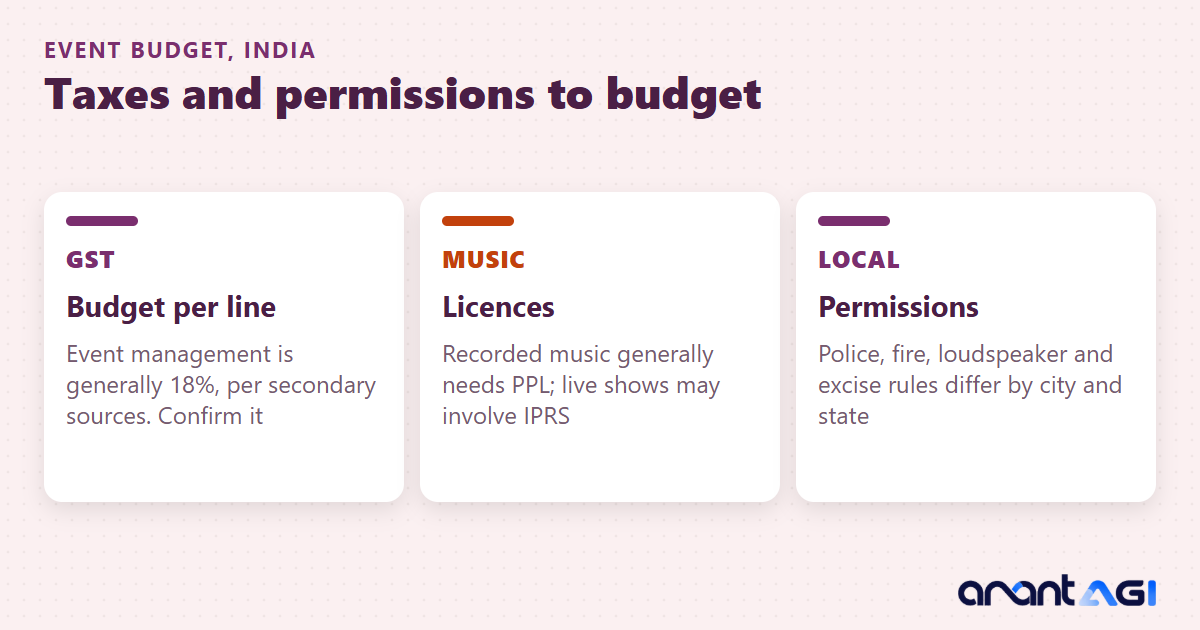
Music licences. Playing recorded music at a public event generally needs a licence under the Copyright Act, 1957, issued by PPL for sound recordings, and live performances may involve IPRS for the compositions (iPleaders explainer). A venue's background-music licence may not cover your event, so ask who holds which licence. Fees and rules change, so get the current amount from the licensing body and put it in the budget.
Local permissions. Police, fire, loudspeaker, and excise rules differ by city and state. Ask the venue and your local authority what is needed and what it costs. Do not guess a figure.
How do you split estimate, actual, paid and balance?
This is the part that most spreadsheets get wrong. They keep one "cost" column, so nobody can tell what was quoted, what was finally billed and what has actually left the bank. Use four columns for every line:
- Estimate: what you expect to spend before booking the vendor.
- Actual: the committed or final amount on the vendor's quote, contract or bill.
- Paid: advances and instalments you have already paid, with date and mode.
- Balance: actual minus paid. This is the cash you still owe.
Keep a fifth column for notes (quote number, due date, who approved it). Compare estimate with actual after each booking, not at the end. If the actual is higher, you can still adjust other lines while there is time. Zoho's guide suggests regular budget check-ins that become more frequent as the event nears, and comparing actuals against plan afterwards to understand each variance.
A copyable event budget template
This is a template, not a recommendation of amounts. Copy it into a spreadsheet, replace the sample lines with your own, and fill in numbers only from real quotes.
| Category | Line item | Estimate | Actual (quoted) | Paid so far | Balance | GST | Due date | Vendor / notes |
|---|---|---|---|---|---|---|---|---|
| Venue | Hall or lawn hire | |||||||
| Venue | Extra hours, setup, cleaning | |||||||
| Catering | Per-plate food and drinks | |||||||
| Catering | Service staff, utensils | |||||||
| Decor | Stage, florals, lighting | |||||||
| AV | Sound, LED, operators | |||||||
| Entertainment | Artist, anchor, DJ | |||||||
| Photography | Photo, video, drone | |||||||
| Staffing | Crew, hosts, uniforms | |||||||
| Permits | Police, fire, loudspeaker | |||||||
| Permits | Music licence | |||||||
| Transport | Guests, artists, material | |||||||
| Marketing | Invitations, signage | |||||||
| Contingency | Reserve | |||||||
| Total |
Add a header block above the table with the event name, date, client, expected guest count, and the version of the budget. Guest count matters because per-head costs such as food change with it, while fixed costs such as venue hire do not (Eventbrite).
How much contingency should you keep?
There is no official number. Published rules of thumb vary. Zoho's guide says an unexpected-expense allowance of about 5 to 10% of the total budget is normal, and that large or hybrid events might need up to 15%. Treat that as a rule of thumb from one vendor guide, not a standard. A first-time event, a new vendor, an outdoor setup in monsoon season or a changing guest count are all reasons to keep more. Keep the reserve as its own line, and write down what each rupee from it was spent on.
How should you handle vendor advances and payments?
Vendors usually ask for an advance to block a date, and the rest in instalments. Large deposits go out well before any money comes in from the client or from ticket sales, so plan the cash flow, not just the total. Zoho's guide makes the same point about deposits and speaker fees leaving before revenue arrives.
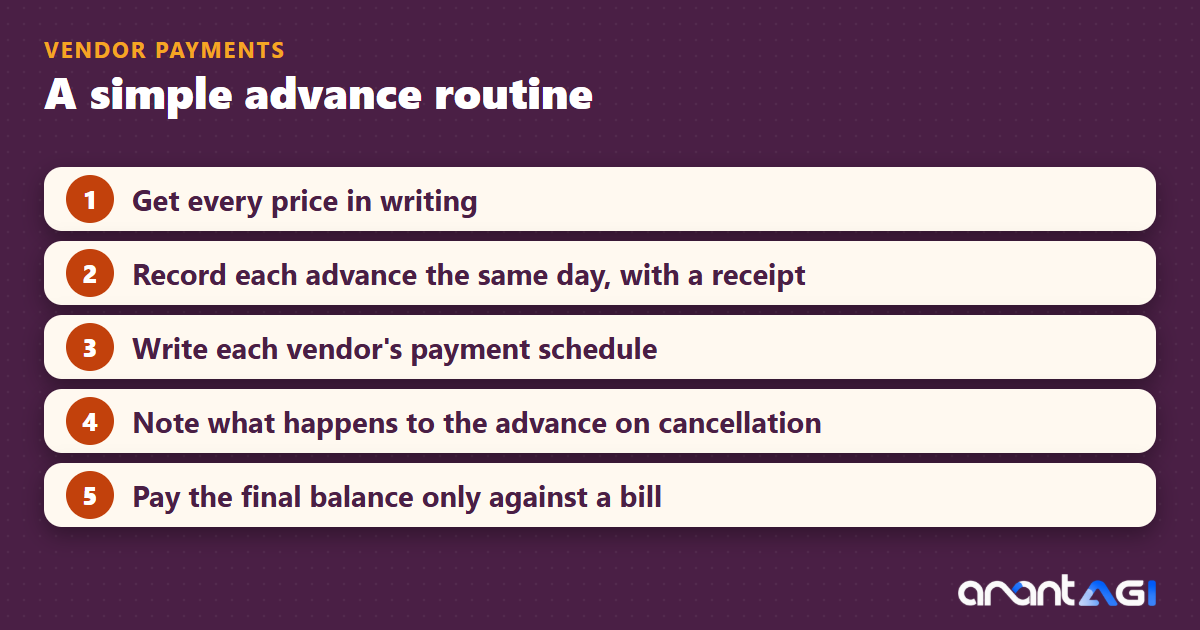
A simple routine that works for most small event businesses:
- Get every price in writing. A message or quote with the date, the scope and the GST treatment.
- Record each advance the same day. Amount, date, mode (bank, UPI, cash), who paid it and who received it.
- Ask for a receipt or acknowledgement. Keep it with the budget line.
- Write the payment schedule per vendor. Advance, interim instalment, final balance and the date by which each is due.
- Check what happens on cancellation. Is the advance refundable, partly refundable or lost? Note it next to the line.
- Pay the final balance only against a bill. Match the bill to the agreed actual amount and note any difference.
- Review "paid vs balance" every week in the month before the event, and every day in the last week.
If you are the planner billing a client, the same four columns work in reverse: what you quoted, what the client approved, what they have paid, and what is pending. For quotes and invoices, see our guide to quotation and invoice software for event planners. Your venue budget line also depends on dates being protected, which is covered in how to stop double bookings.
Checklist: is your event budget ready?
- [ ] Every cost category above has at least one line, or a note saying "not needed".
- [ ] Each line has an estimate, actual, paid and balance.
- [ ] GST is shown per line, and the rate was checked with an accountant or official source.
- [ ] Permits and music licences are listed with who applies and by when.
- [ ] A contingency line exists and is kept separate.
- [ ] Every vendor has a written quote and a payment schedule.
- [ ] Every advance has a date, a mode and a receipt.
- [ ] The guest count and per-head costs are linked, so a change updates the total.
- [ ] One named person approves changes to the budget.
When does a spreadsheet stop being enough?
A spreadsheet is fine for one wedding or one conference. It struggles when several people edit it, when you run many events at once, or when the budget must connect to bookings, quotes and payments. Then the risk is two versions of the truth. If you are comparing tools, use the questions in our event management software buyers checklist for India.
Anant AGI's event tools come from a standalone event platform build (Ayojaan) and are planned / separate build, not features you can use inside Anant AGI today. Treat any budget-tracking feature on our event software page as a direction, and check the current status before relying on it. Until then, the template above works in any spreadsheet.
FAQ
What is the most important thing to include in an event budget?
A line for every cost with four numbers: estimate, actual, paid and balance. Without those, you cannot tell how much is committed and how much cash you still owe.
Should GST be shown separately in an event budget?
Yes, show it per line so you can see the real cost and what your accountant may be able to claim as input credit. Confirm the rate on the official CBIC site or with a chartered accountant, because rates differ by service.
How much contingency should I add?
There is no fixed rule. One published guide suggests roughly 5 to 10% of the total budget, up to 15% for large or hybrid events, so use it as a starting point and raise it for higher-risk events.
Is the advance part of the event cost or a separate item?
The advance is part of the vendor's actual cost that you have already paid. Record it in the "paid" column against that vendor, so the balance shows only what remains.
Do I need a licence to play music at my event?
Often yes. Recorded music at a public event generally needs a licence (PPL), and live performance may involve IPRS, so check with both bodies and the venue before the event.
Sources
- Zoho Backstage, event budgeting guide: zoho.com
- Eventbrite, event expense categories: eventbrite.com
- Razorpay, GST on event management (secondary source; verify on the official portal): razorpay.com
- iPleaders, public performance licensing in India (secondary source): blog.ipleaders.in