
Event Planning Contract Template: Clauses to Include

An event planning contract should name both parties, define exactly what the planner will and will not do, set the fee and payment dates, and say what happens on cancellation, a date change or a force majeure event. This page is a clause checklist, not a legal document. Have a lawyer review your final contract.
What is this page, and what is it not?
It is a list of clauses and a fill-in outline you can take to your lawyer. It is not legal advice, it does not give you ready-made contract wording, and nothing here promises that a particular clause will hold up if it is challenged. I am an events person writing from the planner's side of the table, not a lawyer.
Two things worth knowing before you copy any template from the internet:
- Most templates that rank for this phrase are US or generic downloads from template, e-signature and contract-software sites. The clauses are useful as a checklist, but the legal background is not Indian.
- Indian-specific template pages exist too, but they are commercial pages. One of them says its agreement does not legally require a lawyer, and in the same place recommends independent advice from a qualified Indian lawyer (Forms Legal). Take the second half of that advice.
What the law says about contracts at the most basic level is short. Section 10 of the Indian Contract Act, 1872 says agreements are contracts if made by the free consent of parties competent to contract, for a lawful consideration and with a lawful object, and not expressly declared void. It also says it does not affect any other law that requires certain contracts to be in writing or witnessed, or any law on registration of documents (Section 10, bare act text). Whether your own event contract needs anything extra is a question for your lawyer.
Which clauses should an event planning contract include?
The table is the core checklist. The right-hand column says what to decide, not what to write.
| # | Clause | What to decide |
|---|---|---|
| 1 | Parties | Full legal names, addresses, and PAN and GSTIN where applicable, of the client and your business. Who signs for a company or a family? |
| 2 | Event details | Event type, date, start and end time, venue (or "to be confirmed by" a date), expected guest count and its freeze date |
| 3 | Scope of work | What you will do, in a list. What you will not do, in a second list |
| 4 | Fee and what it covers | Your fee versus pass-through vendor costs; what is inside the quotation and what is extra |
| 5 | Payment schedule | Advance, middle payment, final balance, each with an amount and a calendar date; mode of payment |
| 6 | Vendors | Who chooses vendors, who contracts with them, who pays them, who is responsible if one fails |
| 7 | Changes | How date, guest-count and scope changes are requested, priced and approved (in writing) |
| 8 | Cancellation and date change | What the client owes if they cancel or move the date; what you owe if you cancel |
| 9 | Force majeure | Which events count, how notice is given, postponement or cancellation, and what happens to money already paid |
| 10 | Permissions and licences | Who applies for each permission and who pays for it |
| 11 | Liability and indemnity | Who bears which loss; any cap on liability |
| 12 | Photos, content and credit | Whether you may photograph the event and use images in your portfolio |
| 13 | Disputes and governing law | How a disagreement is raised first; which law and which city |
| 14 | Signatures | Names, date, place, and signed copies for both parties |
The sections below take the clauses that cause most arguments.
How do you write the scope of work so nobody is surprised?
Most disputes between planners and clients are about what was included. A scope clause works best as two lists:
- Included: for example, "venue coordination, vendor booking from the approved list, a run-sheet, a coordinator on the event day for the agreed hours".
- Not included: for example, "vendor costs not in the quotation, additional hours beyond the agreed end time, changes requested after the freeze date".
Attach the quotation to the contract and refer to it by number and date. The layout of that quotation is in event quotation format for planners, and a longer pricing view is in how to price an event package. Keep your budget view consistent with the contract; the event budget checklist lists the cost lines to cover.
If the client asks for a change after signing, do not accept it by phone. A written change request with a new amount and a date, signed or confirmed by message, is a one-line addition to your contract and saves a long argument later.
What should the payment clause say?
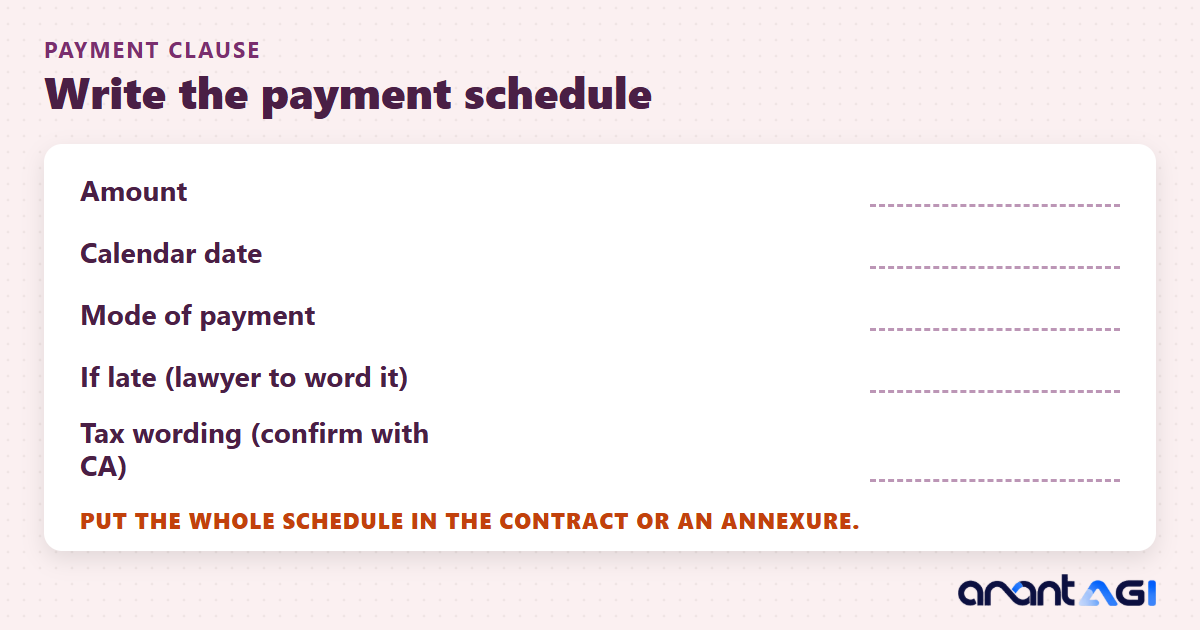
Put the whole schedule in the contract or in an annexure, not only in a chat message. Each line needs an amount, a calendar date and a mode of payment. Say what happens when a payment is late, for example that you may pause work until it is received, and let your lawyer word it.
Do not copy another planner's advance percentage. It should at least cover the vendor advances you must pay in the first weeks, and the logic for that, with a cash-gap check, is in event payment schedule: track advance and balance dues.
Also decide the tax wording. Whether your fee and the vendor costs are shown on one invoice or separately changes how the quotation reads, and GST questions on event services are covered in GST on event management services. Confirm the treatment with your CA before you print it into a contract.
How should cancellation and a non-refundable advance be written?
This is the clause where Indian law has something specific to say, so read it carefully with your lawyer.
Section 74 of the Indian Contract Act, 1872 deals with a contract where a sum is named as payable on breach, or which has any other stipulation by way of penalty. The text on the bare-act page I opened says the party complaining of the breach is entitled to receive from the party who broke the contract "reasonable compensation not exceeding the amount so named or, as the case may be, the penalty stipulated for" (Section 74, bare act text). The same page says a stipulation for increased interest from the date of default may be a stipulation by way of penalty.
In plain words, the section speaks of "reasonable compensation" and an upper limit. I am not telling you how a court would treat your particular "advance is non-refundable" line. Court decisions on forfeiting deposits are mixed in the summaries I read, and that is a lawyer's question. What you can do as a planner:
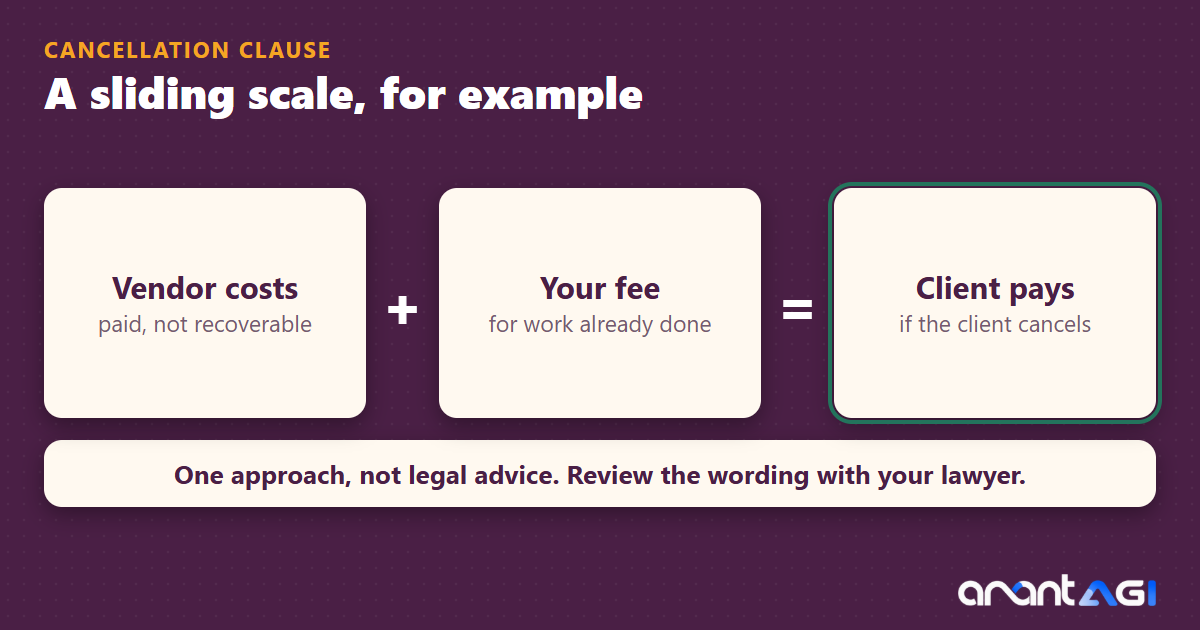
- Write the cancellation clause as a sliding scale linked to real costs, for example the vendor amounts already paid and not recoverable plus your fee for work already done, rather than a single "everything is forfeited" sentence.
- A published India template I opened uses that approach: on client cancellation the client pays committed non-recoverable vendor costs and the manager's fee pro-rated for work completed (Forms Legal). That is a sample from a template site, not a rule.
- State separately what happens on a date change and what happens if you cancel.
- Keep a record of vendor advances paid for each event so the figures in the clause can be shown.
What is a force majeure clause, and what should it cover?
A force majeure clause says what happens when something outside both sides' control stops the event. An Indian law-education page describes these clauses as protecting parties when unforeseen events such as natural disasters, pandemics, riots or government restrictions stop an event (LawBhoomi). The same page calls the Indian Contract Act, 1872 the foundation of the event management industry.
Do not leave it as one generic sentence. Decide and write:
- Which events count. List them. Decide whether government orders, a venue closure or a vendor's failure are included.
- Notice. Who tells whom, in what form and within what time. A template I opened uses 48 hours in writing (Forms Legal); that is a sample term, not a legal requirement.
- Postponement or cancellation. Does the booking move to a new date, and do vendor advances carry over?
- Money. What happens to amounts already paid, and to costs you already incurred.
There is also a statutory default. Section 56 says an agreement to do an act impossible in itself is void, and that a contract to do an act that becomes impossible, or unlawful because of an event the promisor could not prevent, becomes void when the act becomes impossible or unlawful (Section 56, bare act text). How that applies to a cancelled event is a legal judgment, not something a checklist can settle. A written clause that says exactly what happens is the planner's tool; ask your lawyer how it fits with Section 56.
Who gets the permissions, and who is liable if something goes wrong?
Events often need approvals. The LawBhoomi page lists police, fire, municipal, noise, liquor and FSSAI permissions among those that may be required, and warns that failure to obtain mandatory permissions may result in cancellation, fines, criminal action or closure of the event (LawBhoomi). Which ones apply depends on the event, the venue and the city, and I have not verified individual rules from an authority's page. Ask the venue and your lawyer.
For the contract, make a short table and attach it:
| Permission or licence | Who applies | Who pays | Needed by (date) |
|---|---|---|---|
| (to be filled for the event) | Planner / client / venue | Planner / client / venue |
On liability, the same LawBhoomi page describes indemnity clauses as allocating responsibility for losses arising from negligence, misconduct or breach of obligations. Whether to include a liability cap, and how, is a drafting and risk decision for a lawyer. Decide who contracts with vendors too: if the client contracts directly with a vendor, say so, so that you are not treated as responsible for that vendor. A simple vendor tracking method is in event vendor management for small agencies.
What about stamp duty, signing and the lawyer review?
Stamp duty for agreements is a state matter in India, and amounts and requirements differ by state. I could not open a primary source on it for this page, so I am not stating any amount or saying that your contract needs or does not need stamp paper. Ask your lawyer which stamp rules apply in the state where you sign, and about any registration or notarisation question. Section 10 of the Contract Act itself keeps other laws on writing, witnesses and registration of documents intact, as quoted above.
A practical review routine:
- Write your own clause list using the table above.
- Fill the event-specific values from your accepted quotation.
- Send the draft to a lawyer with the questions: stamp duty in our state, cancellation and advance wording, force majeure, liability, dispute resolution.
- Keep the lawyer-approved version as your master. Change only the event-specific fields for each new client.
For the steps before and after signing, see the client onboarding checklist for event planners.
How Anant AGI helps
Anant AGI is building event management for planners, venues and vendors. The event platform where businesses register and list runs at event.anantagi.com, and the planner tools are being connected into the main event software product. Today the main product can create quotations and turn an accepted one into an invoice. Contract generation, e-signature and contract storage are not part of what exists, so keep your lawyer-approved contract in your own files and attach the quotation number to it. Check the current status before relying on any feature.
FAQ
What should an event planning contract include?
At least the parties, event details, scope of work, fee, payment schedule, vendor responsibilities, change process, cancellation, force majeure, permissions, liability and dispute handling. Have a lawyer review the final wording.
Is an event planning contract template enough on its own?
A template is a starting checklist. It cannot know your event, your state's stamp rules or your risks, so use it to prepare a draft and then get it reviewed by a lawyer.
Is a non-refundable advance allowed in India?
This page cannot say. Section 74 of the Indian Contract Act speaks of reasonable compensation not exceeding a named amount, so it is safer to link any forfeiture to real, provable costs and ask your lawyer to word it.
Does an event contract need stamp paper in India?
Stamp duty is state-specific and I could not verify the rules from a primary source. Ask a lawyer which rules apply in the state where the contract is signed.
Who should apply for event permissions, the planner or the client?
It depends on what you agree. Write down each permission, who applies, who pays and the date it is needed by, so there is no doubt later.
Sources
- Indian Contract Act, 1872, Section 10, bare act text: advocatekhoj.com (secondary reproduction; indiacode.nic.in returned an access error)
- Section 74, bare act text: advocatekhoj.com
- Section 56, bare act text: advocatekhoj.com
- Event management legal framework: lawbhoomi.com (law-education page, not an authority)
- Event Management Agreement (India) sample: forms-legal.com (commercial template page, not legal advice)