
Corporate Event Proposal Template for Event Agencies

A corporate event proposal should restate the client's goal, summarise the event, describe your concept, list scope and exclusions, give a timeline, show the budget with your agency fee on its own line, and end with terms and a clear next step. Use the template below and fill it from the client's brief.
A proposal is the pitch: it wins the room. The priced quote that follows is a separate document. For the quote, see event quotation format for planners, and to choose software for it, quotation and invoice software for event planners. This page does not repeat either.
What should a corporate event proposal include?
Template and guide sites agree on a core order. One free corporate template lists an event overview, measurable objectives, target audience, venue and date, agenda, marketing plan, a budget with a contingency line, staffing, risks, and an approval request (Business in a Box). An agency-side guide uses a shorter six-part order: opening vision, event overview, scope of services, timeline, budget and a next step (Clearmargin). A third guide for planners says to open by restating the client's goals so they see you listened, and to include references from similar past events (The Event Planner Expo).
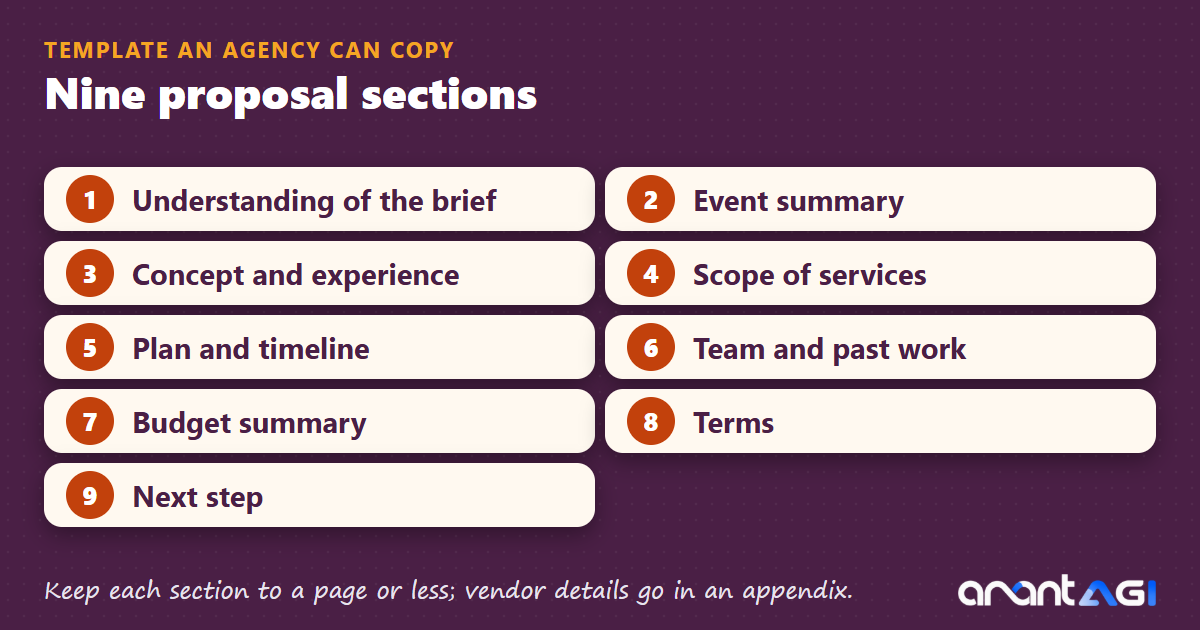
Here is a template an agency can copy. Keep each section to a page or less, and move vendor details to an appendix.
| # | Section | What goes in it | Length |
|---|---|---|---|
| 1 | Understanding of the brief | The client's goal, audience and what success means, in your words | 3-4 sentences |
| 2 | Event summary | Type, proposed date, guest count, city, venue options (or "venue to be confirmed") | Half a page |
| 3 | Concept and experience | Theme, flow of the day, what guests will see and do | 1 page |
| 4 | Scope of services | What you will deliver, split into core and optional; exclusions listed | 1 page |
| 5 | Plan and timeline | Milestones from approval to event day to closing report | Half a page |
| 6 | Team and past work | Who runs it; real past events you can name, with permission | Half a page |
| 7 | Budget summary | Cost groups, your agency fee as its own line, tax, contingency | 1 page |
| 8 | Terms | Validity, payment stages, changes, cancellation | Half a page |
| 9 | Next step | The decision needed, by when, and who to contact | 3 lines |
How do you write each section without padding?
Understanding of the brief. This is the section agencies tend to skip, yet it shows the client you listened. Write it after your call, not from a template. If the client said "launch the product to 200 dealers and collect orders", say exactly that. A vague opener ("we are passionate about events") tells the client nothing.
Measurable success. The Business in a Box guidance says to replace soft objectives with specific metrics, such as leads generated, satisfaction scores, funds raised or media mentions. Only promise a metric you can actually influence and measure. "Dealer attendance of at least X" is fair if the client controls invitations; "increase sales" is not yours to promise.
Concept. Describe the guest's experience in time order: arrival, registration, opening, sessions, breaks, close. Give a start and end time to each block with buffers between them. Visuals help, but do not let them hide the offer.
Scope and exclusions. List what you will do, then what you will not. Typical exclusions are venue rent, permissions and licences the venue or authority asks for, and anything not named in the scope. If the client asks for more later, issue a revised version instead of agreeing in chat.
Timeline. Work backwards from the event date. Show only milestones you control, such as concept approval, vendor confirmation, site visit, run-of-show sign-off and the post-event report. Dates that depend on the client (content, logos, guest list) should say "client to provide by".
References. Include real past events and contacts only with the client's permission. If you are new and have none, say so and offer a site visit or a smaller paid trial instead of inventing proof.
How should the agency fee appear in the proposal?
Show your fee as its own line, separate from the money passing through to vendors. One guide says the planning fee is distinct from the event budget spent on vendors and services, and that hidden markups destroy trust (Clearmargin). Pick one of two honest ways to state it:
- Pass-through: vendor costs are billed at the contracted rate, and the fee covers your planning and coordination.
- Disclosed markup: the fee line says it includes your margin on vendor services.
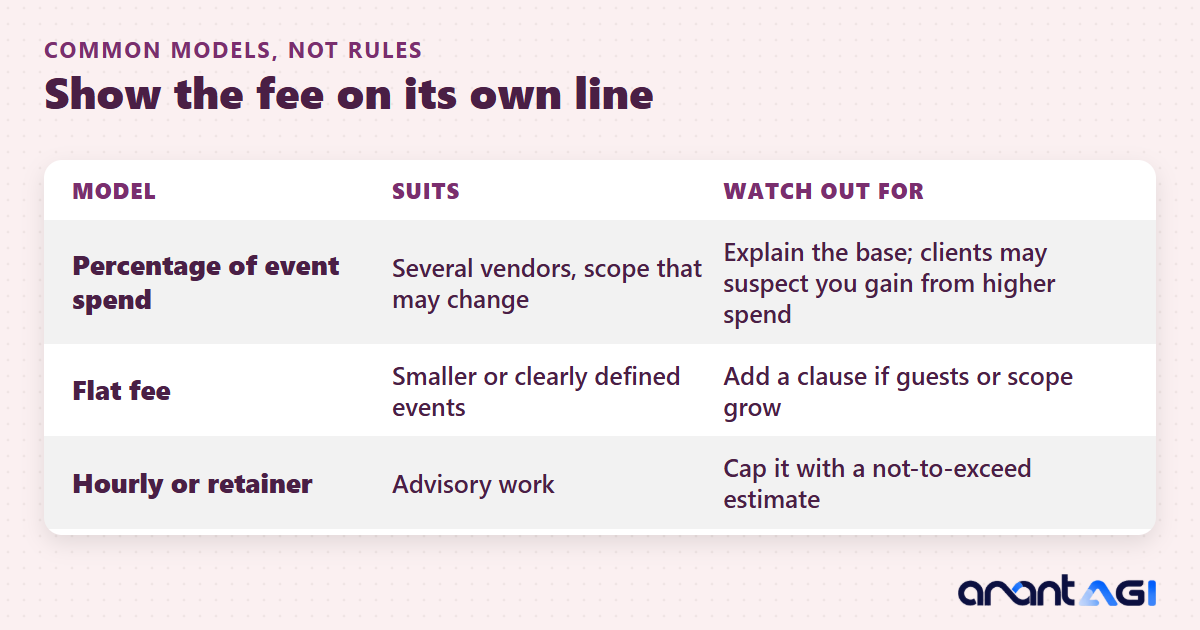
Common fee models, as described by guides (not rules):
| Model | How it works | Suits | Watch out for |
|---|---|---|---|
| Percentage of event spend | A share of total spend or of confirmed vendor cost | Several vendors, scope that may change | Guides quote about 10-20%, but they are mostly UK and US sources. Clients may suspect you gain from higher spending, so explain the base |
| Flat fee | One fixed amount for a defined scope | Smaller or clearly defined events | Add a clause for what happens if guests or scope grow |
| Hourly or retainer | Time-based billing | Advisory work | Cap it with a not-to-exceed estimate |
Do not copy a percentage from a blog. Work out your own cost to deliver, then pick the model. If you need help sizing a package, read how to price an event package.
What does a short filled sample look like?
The numbers below are made up to show layout and arithmetic. They are not market rates, and the event is fictional. Copy the structure, not the prices.
Proposal: Dealer Meet 2027 | Prepared for: Sample Client Pvt Ltd | Valid until: 31 Dec 2026
1. Understanding of your brief: You want to bring about 200 dealers together for one day to launch the new product range and collect advance orders, with a smooth registration and a clear order process.
2. Event summary: One-day dealer meet, proposed date 18 Feb 2027, city to be confirmed with you, 200 guests (assumed), 10 am to 6 pm, venue options attached in the appendix.
3. Scope: Venue shortlisting and booking support, stage and AV, registration desk, guest handling, run-of-show, lunch coordination, on-site team and a closing report. Excluded: venue rent, travel and stay for guests, permissions asked by the venue or authority.
7. Budget summary (illustrative):
| Group | Basis | Amount (Rs) |
|---|---|---|
| Stage, AV and lighting | Vendor estimate, to be confirmed by quote | 2,00,000 |
| Registration and branding | Vendor estimate | 80,000 |
| Food and beverage | 200 guests x assumed rate | 1,40,000 |
| On-site team | 6 persons, 1 day | 24,000 |
| Vendor and direct costs | 4,44,000 | |
| Contingency (assumed 7%) | On vendor and direct costs | 31,080 |
| Agency fee (flat, defined scope) | Planning and coordination | 60,000 |
| Subtotal before tax | 5,35,080 | |
| GST | At the rate your CA confirms for your structure | Added at quote stage |
Notice that the proposal gives ranges or estimates marked "to be confirmed". The exact priced, itemised document comes next, as the quotation. Guides suggest a contingency line in the budget: Clearmargin says 5-10% and Business in a Box says typically 10-15%, so choose what fits the event's uncertainty and say it is an assumption. Work through the internal cost side in the event budget checklist first, so the figures you show are not guesses.
How should terms and the next step read?
Keep terms short and specific: how long the proposal is valid (a date, not "30 days"), the payment stages, how changes are handled, and what happens on cancellation or postponement. One guide suggests a deposit followed by milestone payments, a final payment two to four weeks before the event, and tiered cancellation terms, and says vendor deposits and cancellation fees are the client's responsibility, separate from your fee (Clearmargin). Those are one site's suggestions, not law. Have a lawyer review your cancellation wording once, then reuse it. The payment stages themselves are covered in event payment schedule: advance and balance.
End with one decision: "Please confirm the concept by 31 Dec 2026 so we can hold the venue and vendors." Tie the date to a real constraint, such as a venue hold, and not to invented urgency.
What should you check before sending?
- [ ] The first paragraph repeats the client's own goal, in their words.
- [ ] Success is stated as something measurable that you can influence.
- [ ] Guest count, hours, date and venue are written as assumptions where not final.
- [ ] Scope and exclusions are both listed.
- [ ] The agency fee is a separate line, and the markup policy is stated.
- [ ] Contingency is shown, with the percentage marked as an assumption.
- [ ] Tax is not hidden; the basis (before or after tax) is clear.
- [ ] Validity is a date; the next step has a decision date.
- [ ] References are real, with permission. No invented case studies.
- [ ] Length is readable: main body short, vendor specifications moved to an appendix.
How Anant AGI helps
Anant AGI today lets a business create quotations, send them by link or PDF, see when a quotation is accepted, and turn it into an invoice, so the numbers you propose can flow into a priced quote without retyping. A proposal builder, an event item library and event-wise tracking are not part of Anant AGI yet; the event features are a separate event build. Check the event software page for the current status. A proposal works fine as a document or slide deck with the template above.
FAQ
What is the difference between an event proposal and a quotation?
A proposal pitches your understanding, concept, plan and estimated budget to win the work. A quotation is the priced, itemised offer the client accepts, with exact quantities, rates, tax and payment terms.
How long should a corporate event proposal be?
Long enough to cover the nine sections above and no longer. We have not found a rule for page count; keep the main body short and move vendor specifications to an appendix.
How do I show my agency fee in an event proposal?
Show it as a separate line from vendor and direct costs, and say whether vendor costs are passed through at contract rates or include a disclosed markup. Guides describe percentage, flat and hourly models; choose the one that matches your real cost and the event's scope.
Should a proposal include prices?
Yes, at summary level: cost groups, your fee and contingency, with estimates marked as such. Final item-by-item prices belong in the quotation once vendor quotes are confirmed.
Can I use the same template for a wedding or a product launch?
The structure is the same. Change the objectives, concept and success measures; a corporate brief needs business outcomes, while a social function needs guest experience and family priorities.
Sources
- Business in a Box, event proposal template: business-in-a-box.com (template vendor guidance)
- Clearmargin, how to write an event planning proposal: clientcasa.com (agency-side guide; fee ranges are mostly UK and US and not rules)
- The Event Planner Expo, build a winning corporate event client proposal: theeventplannerexpo.com (planner guidance)