
What Is Field Service Management Software?

Field service management software schedules and tracks work done by technicians who go to the customer's site rather than a fixed workplace - scheduling and dispatch, the parts and tools each job needs, and an invoice tied to the completed visit.
For a medical equipment service company, that means every PM visit, breakdown call and AMC renewal runs through the same system instead of a phone call and a paper job sheet.
What does field service management software actually include?
Across vendor and industry sources, the common modules are:
- Scheduling and dispatch - assigning the right technician to the right job, often based on location and skill
- Workforce management - technician availability, routes and working hours
- Parts and equipment tracking - what's needed for a job, and what's actually in stock
- Customer and asset records - which machine, at which customer, with what service history
- Invoicing - turning a completed visit into a bill, often linked to accounting software
- Mobile access - technicians work from a phone or tablet in the field, not a desktop back at the office
Why does this matter specifically for equipment service companies?
A PM visit, a breakdown call and an AMC renewal all involve the same core question: which technician, at which customer, working on which specific machine, and what's the service history on that exact asset? Generic scheduling tools track people and time; field service software for equipment ties the job to the asset's own history - previous visits, parts replaced, open issues - so a technician arrives knowing what happened last time, not starting cold.
Who typically uses field service management software?
Industries named across comparisons include HVAC and plumbing, telecommunications, utilities, healthcare equipment, and transportation - any business where the work happens at the customer's location rather than a shop or office. Medical and rental equipment service fits the same pattern: the asset doesn't come to you, you go to the asset.
What should an equipment service company look for specifically?
| Feature | Why it matters for equipment service |
|---|---|
| Asset-level history, not just customer-level | A customer may have five machines with different service needs |
| AMC and warranty tracking per asset | Determines who pays for the visit and whether parts are covered |
| Spare-parts inventory tied to the job | Avoids a technician travelling without the part they need |
| SLA and response-time tracking | Hospitals and imaging centres often have contractual response windows |
| Mobile checklist for the technician | PM visits usually follow a fixed checklist that shouldn't vary by memory |
Is field service software the same as a CRM?
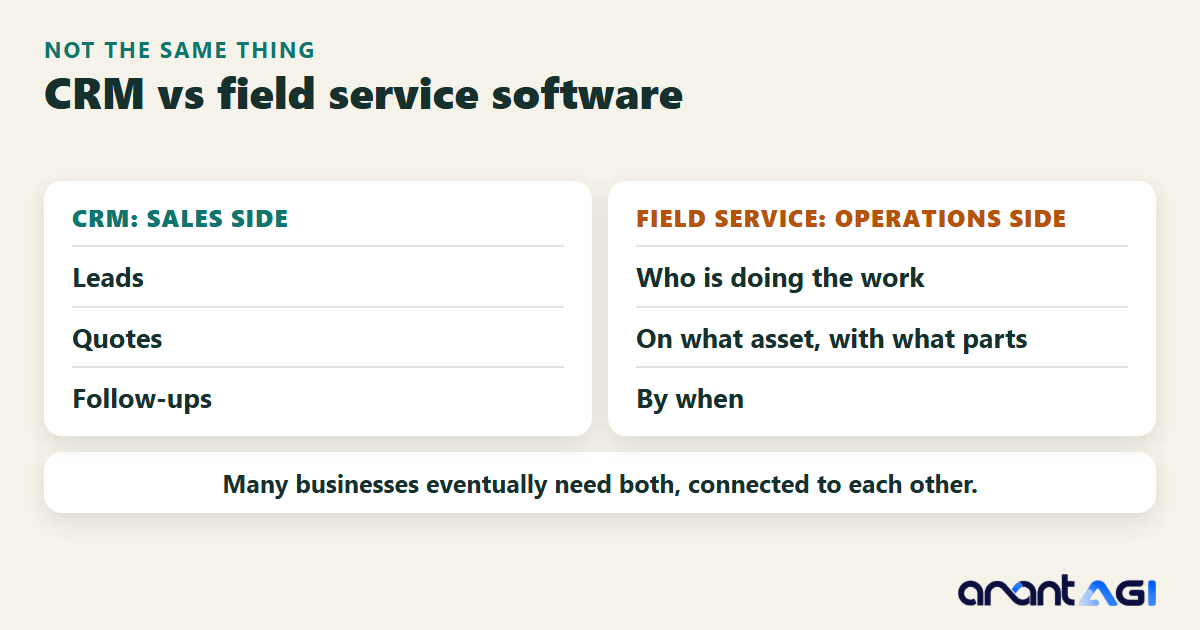
No. A CRM tracks the sales relationship - leads, quotes, follow-ups. Field service software tracks the operational side - who's doing the work, on what asset, with what parts, by when. Many businesses eventually need both, connected to each other, rather than one standing in for the other.
What happens without it?
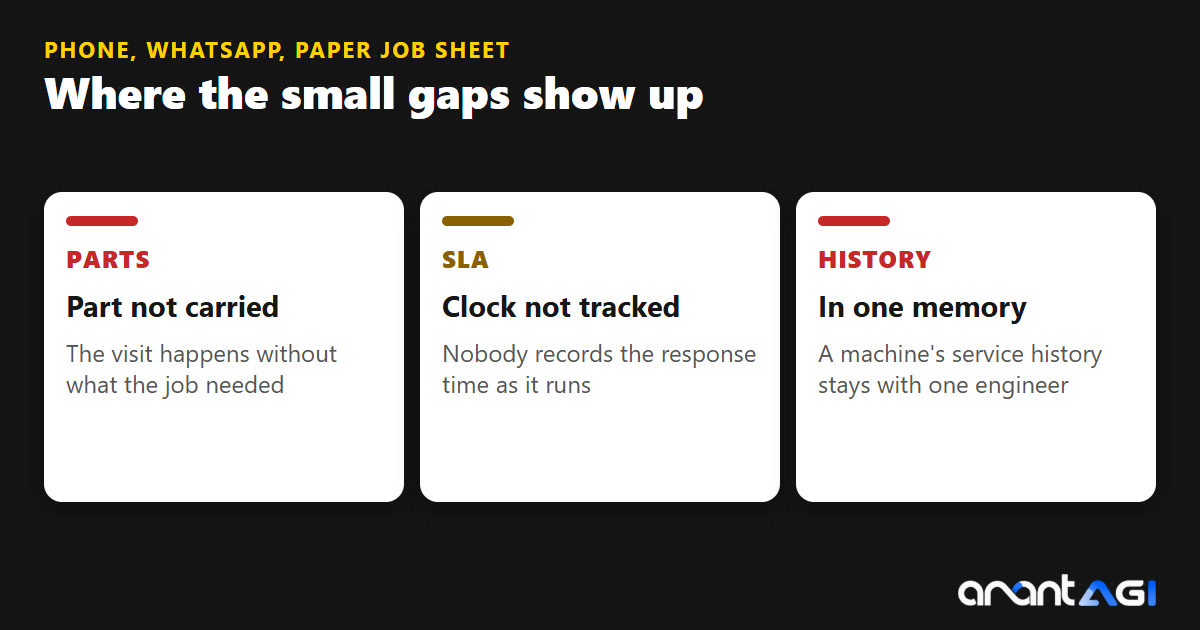
Most equipment service companies without a field service system run on some combination of a phone call to the engineer, a WhatsApp message with the address, and a paper job sheet that gets filed (or lost) after the visit. This works until something goes wrong - a part wasn't carried, the SLA clock wasn't tracked, or the service history for a specific machine exists only in one engineer's memory. The failure mode isn't dramatic; it's a slow accumulation of small gaps that surface exactly when a customer asks a pointed question during a renewal negotiation or an audit.
How Anant AGI helps
Anant AGI's equipment-service pack is built around field service for this exact vertical: an asset register per machine, AMC contract records, service tickets with SLA, PM visit scheduling and dispatch, and a spare-parts catalogue - the same structure this post describes, applied to medical and rental equipment specifically. See how to track AMC renewals for how the AMC side of this fits together.
FAQ
Is field service management software only for large companies?
No - the core problem (technicians working off-site, needing scheduling and a service history) exists at any size. Smaller companies often start with a simpler version and add modules as they grow.
Does field service software replace a service engineer's judgment?
No. It organizes the information a technician needs (history, parts, SLA) - the actual diagnosis and repair still depend on the engineer's expertise.
Can field service software work without internet at the customer site?
Many mobile apps support offline mode that syncs once connectivity returns, but check this specifically if your technicians regularly work in low-signal locations like basements or shielded rooms.
Is field service software expensive?
Pricing varies by features, number of technicians and customization, similar to most B2B software. Ask for a quote based on your actual team size rather than a published starting price.
What's the difference between field service software and a maintenance management system (CMMS)?
A CMMS is often used by the equipment owner to manage their own assets; field service software is typically used by the service provider managing visits across multiple customers' assets. There's overlap, and some products do both, so the label on a product matters less than what it actually tracks for your specific situation.
Sources
- Oracle, what is field service management software: oracle.com
- Salesforce, field service management software complete guide: salesforce.com