
Annual Maintenance Contract Example for CT and MRI

An annual maintenance contract example for a CT or MRI machine should state the equipment covered, the number of preventive maintenance visits, response and uptime commitments, what is excluded, the term, payment and renewal. Below is a clause list and a copyable skeleton. It is a template for discussion, not legal advice.
This guide is about maintenance contracts for medical imaging equipment: CT scanners, MRI systems and similar machines in hospitals and imaging centres. It is written from the service side, so it shows what a clear contract looks like to the person who has to deliver it, and what a buyer should insist on before signing.
Contract names are not fixed by law. "AMC" and "CMC" mean different things at different vendors, so the wording decides everything. For the difference between the two types, read AMC vs CMC for medical equipment first.
What should a CT or MRI maintenance contract cover?
Start with the equipment schedule. List the make, model, serial number and site address of every machine, plus the accessories that are in scope. For MRI, say clearly whether coils, the magnet and cryogen system, and the cooling equipment are included. For CT, say whether the X-ray tube and detector are in scope.
Then describe the work in plain words:
- Preventive maintenance (PM) visits, including how many per year and who schedules them
- Breakdown (corrective) calls, including whether they are unlimited or capped
- Engineer labour and travel, and whether after-hours or holiday calls cost extra
- Software support, such as fixes and upgrades, if the vendor offers them
- Reports: a service report for every visit, signed by your staff
If an item is not written down, treat it as not confirmed. A contract that is silent on a part, a coil or a software licence usually leads to an argument later.
What are the key clauses in an annual maintenance contract?
The table below lists the clauses that matter most for CT and MRI, and what a buyer or seller should check in each. The "watch for" column is general market practice, not a rule.
| Clause | What it should say | Watch for |
|---|---|---|
| Scope | Machines, serial numbers, accessories, site | Missing accessories, relocated machines |
| PM visits | Number per year, who books them, a visit calendar | Visits "as required" with no number |
| Response time | Hours to acknowledge and hours to be on site, from when the call is logged | The clock starting only in coverage hours |
| Coverage hours | Weekdays only, or extended, and holiday cover | Hours that do not match your clinical timetable |
| Uptime | A percentage, how it is calculated, and what happens if it is missed | Exclusions that swallow the guarantee |
| Parts | Which parts are covered, new or reconditioned, delivery speed | Tubes, detectors, coils named as "excluded" |
| Consumables | What counts, for example MRI helium | Caps on helium or cryogen cost |
| Exclusions | Misuse, power or room conditions, accidents, third-party work | Vague words such as "other causes" |
| Term | Start and end dates, auto-renewal or not | Auto-renewal with a short notice window |
| Payment | Amount, GST, instalments, due dates | Full advance with no refund rule |
| Renewal | Notice period, price review basis | Large unexplained increases |
| Termination | Notice by either side, what happens to prepaid fees | One-sided exit rights |
For the tax side of the invoice, see GST invoice for an AMC service contract.
How are response time and uptime written in an MRI or CT contract?
These two are often confused, and they are not the same thing.
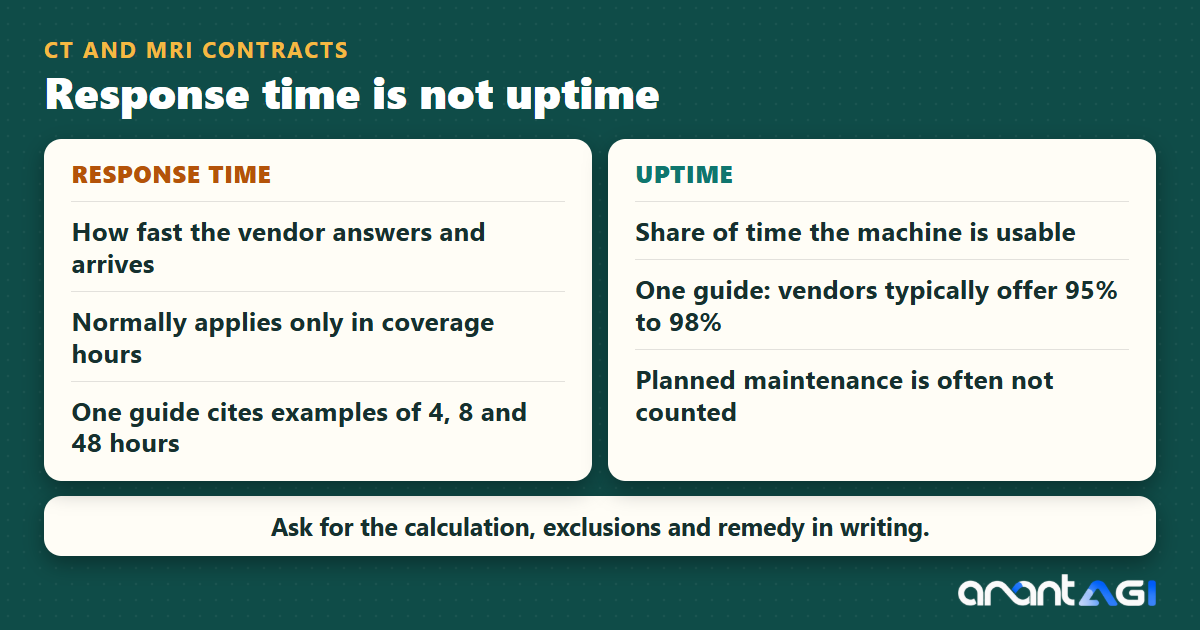
Response time is how fast the vendor answers and arrives. One industry guide on imaging service contracts says on-site response is measured from when the customer reports that the equipment is down, and that it normally applies only during the contracted coverage hours. That guide cites examples of 4, 8 and 48 hours. A call logged outside coverage hours starts the clock when coverage resumes, so a Tuesday evening call under weekday daytime cover may mean a visit on Thursday.
Uptime is the share of time the machine is usable for patients. The same guide reports that vendors typically offer an uptime guarantee between 95% and 98%, depending on the contract type. It notes that downtime generally does not start until the vendor is told, and that planned maintenance, tube replacement and upgrades are often not counted. Ask for the calculation in writing: which hours count, what is excluded and what remedy applies.
Whatever a vendor's own terms say about uptime, read them as that vendor's claims, not as an industry standard. If the vendor needs a remote connection to the machine, ask whether losing that connection affects your rights under the contract.
What do CT and MRI contracts usually exclude?
Exclusions are where most disputes begin. Common examples from industry guides, which vary from contract to contract and are often negotiable:
- Helium and cryogens: MRI helium cover is often capped. One imaging reseller says it covers a set number of litres per year on its full contract, and that a single fill can be very expensive. Ask whether the cap applies per year or per event.
- Quenches with no equipment fault: If a quench has no identifiable equipment failure, the same source says most contracts will not cover it.
- Chillers: A chiller is cooling (HVAC) equipment, not imaging equipment, so contracts differ on whether it is in scope. It matters because chiller failure can take the MRI down.
- Room and environment: Room temperature, humidity, vibration from nearby traffic and unstable power are frequently excluded.
- Major components: X-ray tubes, detectors and magnet work are sometimes carved out of a basic AMC and covered only in a comprehensive contract. Confirm each one by name.
- Training, manuals and proprietary software: Often billable.
- Misuse and disasters: Damage from misuse, negligence or events outside the vendor's control is generally excluded.
Do not assume. If your site has an unreliable power supply, a clause that excludes "power issues" matters a great deal, so ask for a stabiliser or UPS requirement to be written down rather than discovered after a failure.
What should you ask the vendor before signing?
Use these questions in the meeting. They work for a buyer reading a quote and for a service company writing one.
- Which exact machines, serial numbers and accessories are covered?
- How many PM visits per year, and can we see the visit calendar now?
- When does the response clock start, and what are the coverage hours?
- Is there an uptime percentage? How is it calculated, and what do we get if you miss it?
- Which parts are covered? Name the tube, detector, coils and cooling system.
- For MRI, what is the helium or cryogen policy and any cap?
- Are parts new or reconditioned, and how fast are they delivered?
- What is excluded, in a list we can read before we sign?
- How does renewal work, and how much notice is needed to leave?
- Who owns the visit reports and breakdown logs, and when do we get them?
Annual maintenance contract example: a template skeleton
Below is a skeleton you can copy and adapt. It is a template to start a discussion, not legal advice. Have your lawyer review the final text, and replace every bracket with your actual terms.
ANNUAL MAINTENANCE CONTRACT: [CT / MRI] SYSTEM
1. Parties. [Service provider name and address] and [Customer name and address].
2. Equipment. [Make, model, serial number, location]. Accessories covered: [list]. Anything not listed is not covered.
3. Term. From [start date] to [end date]. Renewal only by written agreement, with [__] days' notice before expiry.
4. Services. [__] preventive maintenance visits per year on dates agreed at signing. Breakdown calls: [unlimited / up to __]. Engineer labour is included. A signed service report is issued for every visit.
5. Response. The provider will acknowledge a logged call within [] hours and attend on site within [] hours, measured from the time the call is logged, within coverage hours of [days and times].
6. Uptime. [Include only if agreed.] Target uptime of []% per [month / year], calculated on [hours]. Excluded from downtime: planned maintenance, customer-caused faults, power or environment outside the manufacturer's specification, [other listed items]. Remedy if missed: [].
7. Parts. Covered: [named parts]. Not covered: [named parts, for example tube, detector, coils]. Replacement parts are [new / reconditioned].
8. Consumables and cryogens. [For MRI: helium policy, cap and who pays above the cap.]
9. Exclusions. Misuse or negligence, room or power conditions outside specification, work by third parties, accidents or events outside the provider's control, [other listed items].
10. Customer duties. Provide access, a suitable environment and power, report faults promptly and in writing, keep [remote connection, if required] active.
11. Fees and payment. Annual fee [amount] plus applicable GST, payable [in full / in instalments of __] by [dates]. Extra work outside scope is quoted and approved in writing first.
12. Renewal and price review. Price review basis: [stated basis]. Notice period: [__] days.
13. Termination. Either party may terminate with [] days' written notice for [stated reasons]. Treatment of prepaid fees: [].
14. Records. Visit reports, call logs and parts used are shared with the customer on request within [__] days.
15. Governing law and disputes. [As advised by your lawyer.]
How should a service company track the contract once it is signed?
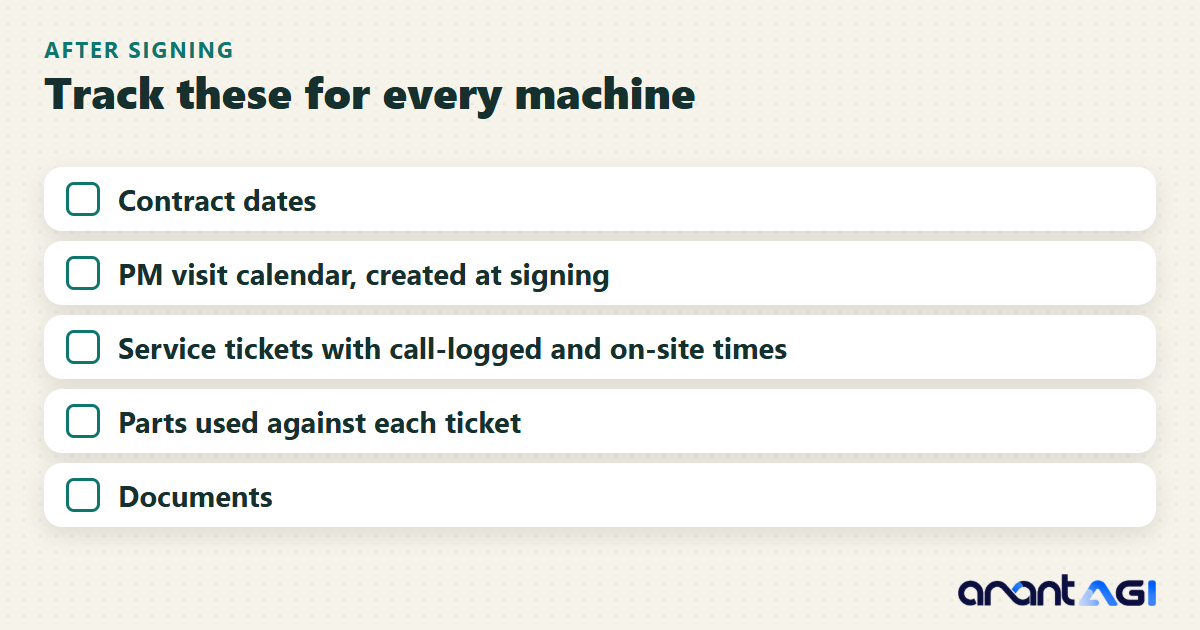
A good contract still fails if nobody delivers it. At minimum, track per machine: the contract dates, the PM visit calendar created at signing, service tickets with call-logged and on-site times, parts used against each ticket and the documents. That same history is what you need at renewal. The checklist in how to track AMC renewals shows the staged process.
How Anant AGI helps
In the Anant AGI equipment-service pack, the product code already holds the building blocks: an asset register, AMC contract records, service tickets with SLA, PM visits and dispatch, a spare-parts catalogue, agreement documents and a customer portal. A renewal-expiry detector for AMC contracts is part of the Revenue Recovery design. Tuning that detector, WhatsApp reminders and payment links are listed as still to do, so confirm current status before you rely on them. Anant AGI does not provide legal contract templates or advice; the skeleton above is a starting point only. See the blog for related guides.
FAQ
What is included in an annual maintenance contract for a CT or MRI machine?
Typically a set number of preventive maintenance visits, engineer labour and often breakdown attendance, with parts and consumables depending on the contract type. The signed schedule of inclusions and exclusions is what counts, not the label.
Does an AMC cover helium for an MRI?
Not automatically. Helium and cryogen cover is often capped or excluded, so ask for the policy and the cap in writing.
What uptime percentage should an imaging contract guarantee?
One industry guide reports that vendors typically offer between 95% and 98%, depending on the contract. The calculation basis and exclusions matter as much as the number.
Can I use this annual maintenance contract example as a legal document?
No. It is a skeleton to organise your discussion, and a lawyer should review the final contract for your situation.
How early should I plan renewal of a CT or MRI maintenance contract?
There is no fixed rule, but starting the renewal review well before expiry gives you time to compare visits done, breakdowns and parts used. Many service teams start around 90 days before.
Sources
- 24x7 Magazine, "Service contract management II" (uptime, response time and negotiation points for imaging equipment): 24x7mag.com
- Block Imaging, "MRI service contracts: what's not included" (helium, quenches, chillers and environment): blockimaging.com