
"How to Host a Trivia Night at Home: A Simple Plan"

To host a trivia night at home, split guests into small teams, write about five rounds of five to eight questions, give each team an answer sheet, mark after every round and keep a visible scoreboard. Pick one quizmaster, agree a no-phones rule and have a tie-breaker ready before you start.
A trivia night is a quiz with a social layer on top. The preparation is mostly writing, so do that a day or two early. This guide covers only the quiz format. For the wider evening, such as seating, snacks and choosing other games, see how to host a game night.
What do you need for a trivia night at home?
Very little. A home quiz needs a quizmaster, questions with answers written down, and a way for teams to record replies.
| Item | Why you need it | Home substitute |
|---|---|---|
| Question sheet with answers | The quizmaster reads from it | Notes on a phone that only the host sees |
| Answer sheets, one per team per round | A written record stops arguments | Any scrap paper with team name and round number |
| Pens | One per team is enough | Pencils |
| Scoreboard | Teams want to see where they stand | A chart paper, whiteboard or the back of a carton |
| Timer | Keeps rounds moving | Phone timer held by the host |
| Tie-breaker question | Settles a draw quickly | A closest-number question, described below |
A simple answer sheet has the team name and round number at the top and numbered lines below. Escapely's hosting guide also suggests printing the categories and point values on the sheet, keeping spare copies and being clear about how sheets get handed in.
How many teams, and how big?
For a living room, teams of three to five usually work well. That is our suggested starting point, not a tested figure. Pub quizzes, for comparison, often form teams by table, and some cap a team at six to ten people, according to the Wikipedia article on pub quizzes.
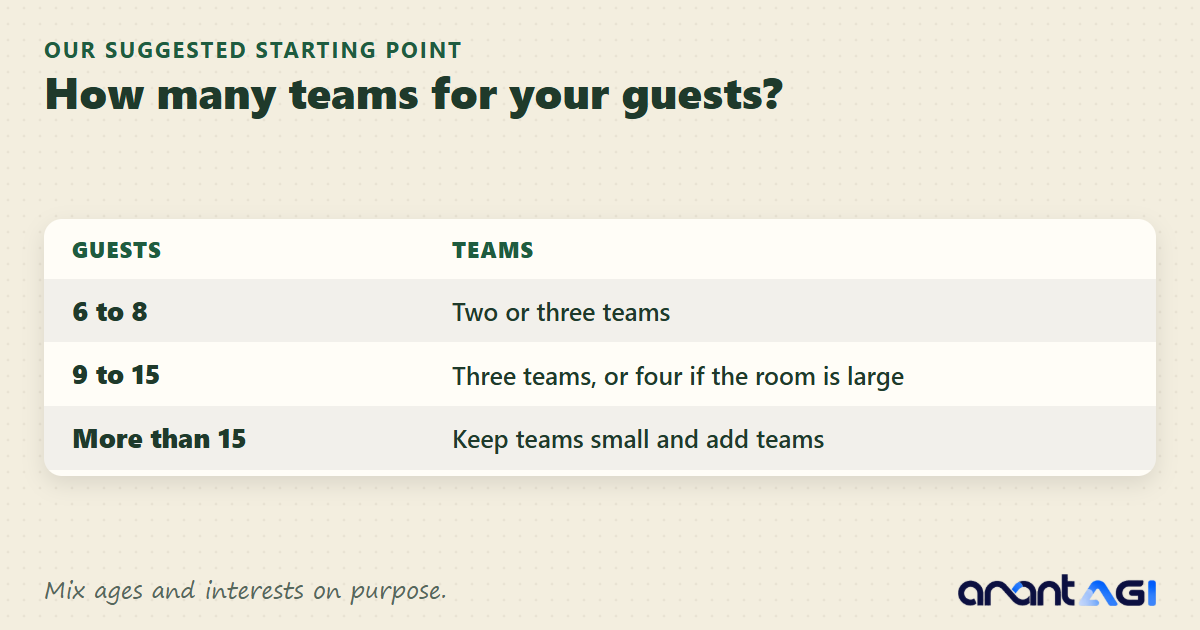
- Six to eight guests: two or three teams.
- Nine to fifteen guests: three teams, or four if the room is large.
- More than fifteen: keep teams small and add teams instead of making each team bigger.
Mix ages and interests on purpose. A team with a cricket follower, a film fan, a good speller and a grandparent covers far more ground than four college friends who know the same things. If your gathering is large, party games for large groups has ideas for keeping everyone involved.
How many rounds and questions should you plan?
Plan five rounds of six questions for a first quiz. That gives 30 questions, which is enough to feel like an event without dragging. Escapely suggests five to eight rounds as a good starting point, adjusted to your group's time and energy. Within that, keep each round between five and eight questions.
| Part of the evening | What happens | Rough time (our estimate) |
|---|---|---|
| Welcome and rules | Form teams, pick names, explain scoring | 10 minutes |
| Rounds 1 and 2 | Easy general and word questions | 20 minutes |
| Break | Food, drinks, a look at the scoreboard | 10 minutes |
| Rounds 3 to 5 | Numbers, family round, year-in-review | 30 minutes |
| Tie-breaker and results | Only if needed | 5 minutes |
The times are a planning aid, not a promise. Chatty groups take longer, especially when answers are read out.
Order matters more than people expect. Open with questions most guests can answer, put the harder ones in the middle and finish with the round everyone cares about, usually the family or year-in-review one.
What are some original sample questions to start with?
These were written for this post. They are deliberately checkable by logic, spelling or arithmetic, so you do not have to trust anyone's memory. Use them as warm-ups and add your own.
Round 1: warm-up
- Which month of the year has the fewest days? (February)
- How many sides does a hexagon have? (Six)
- What is the opposite of "ancient"? (Modern)
- In chess, which piece moves in an L shape? (The knight)
- Which Indian festival is often called the festival of lights? (Diwali)
Round 2: words
- Rearrange the letters of EARTH to make a part of the body. (Heart)
- Rearrange LISTEN to make a word that means quiet. (Silent)
- How many vowels are in the word "education"? (Five)
- Which word becomes "shorter" when you add two letters to it? (Short)
- Spell "level" backwards. (Level)
Round 3: numbers
- If today is Wednesday, what day will it be in 10 days? (Saturday)
- What is 15 per cent of 200? (30)
- A film starts at 7:40 pm and runs for 2 hours 35 minutes. When does it end? (10:15 pm)
- Three friends split a bill of 750 rupees equally. How much does each pay? (250 rupees)
- How many minutes are there in one day? (1,440)
Add a sixth question to each round from your own group's interests: a dish everyone cooks, a song everyone knows or a street near home.
How do you build the family round and the year-in-review round?
These two rounds make a home quiz worth more than a printed quiz book, because nobody can look the answers up. Collect the facts privately from one or two people before the evening.
Family round templates:
- Who in this room woke up earliest this morning?
- Which dish did the host cook most often this year?
- What was the first job or school of the eldest person here?
- How many cousins does a named relative have?
Year-in-review templates:
- In which month did our family or group take its big trip?
- Who in the group started something new this year, and what was it?
- Which film did we watch together most recently?
- What was the headline moment in our own family this year?
If you add public news, sport or film questions about the year, check every answer against a reliable source on the day you write it. A wrong answer from the quizmaster causes more argument than any hard question. Avoid politics, health news about people and anything that could embarrass a guest.
How should scoring work?
Keep it to one point per correct answer. The Wikipedia article on pub quizzes describes this as the usual approach, with some quizzes giving half marks for nearly right answers or extra points for hard ones. At home, skip half marks unless you decide the rule before the first question.
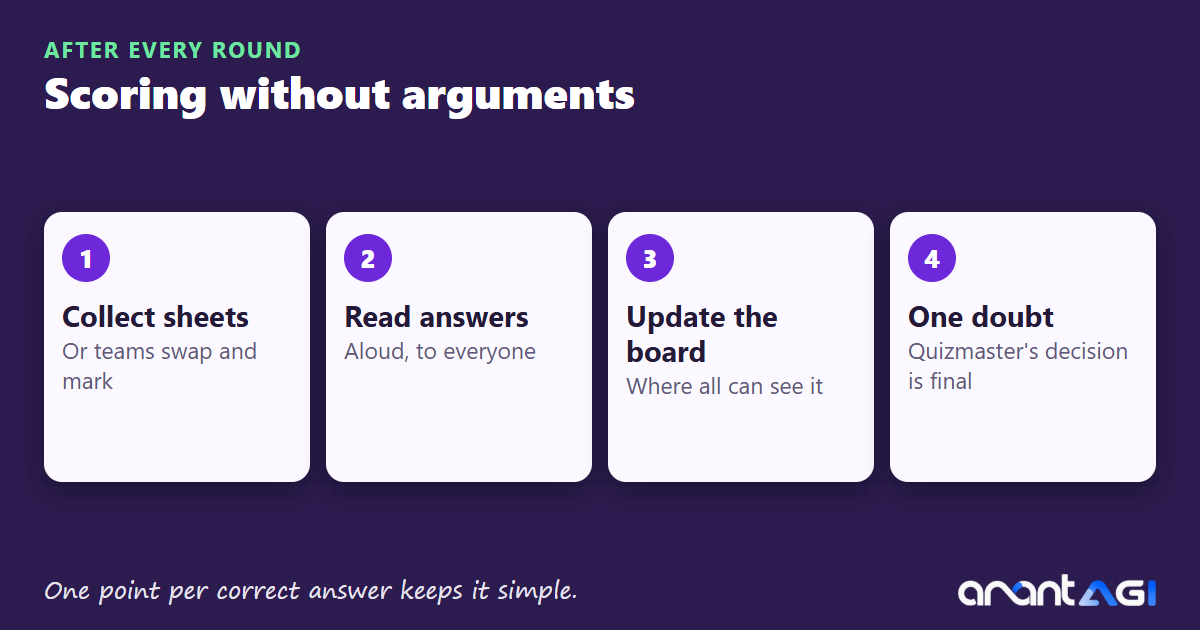
- Collect sheets at the end of each round, or have teams swap sheets and mark each other's.
- Read the correct answers aloud.
- Add the round total to the scoreboard where everyone can see it.
- Let teams raise a doubt once. The quizmaster's decision is final.
If you want a little strategy, borrow the joker idea from pub quizzes: before the quiz, each team names one round in which its points count double. It is optional and works best when round titles are announced in advance.
What about tie-breakers? Prepare one or two before you begin. A closest-number question settles any draw. For example, put dry beans in a jar, count them while setting up, and ask each tied team to guess. The closest guess wins.
How do you stop phones from spoiling the quiz?
Say the rule out loud before round one: phones stay face down or in a basket during questions. Escapely recommends a no-phones zone, since phones tempt players to search for answers. Allow a break between rounds so guests can check messages.
If a child or grandparent needs a phone for a real reason, let them keep it and trust them. This is a home game, not an exam.
What does a good quizmaster do?
- [ ] Reads each question clearly, then repeats it once.
- [ ] Checks every answer before the evening, not during it.
- [ ] Accepts reasonable alternative answers and says so to everyone.
- [ ] Keeps rounds moving with a timer.
- [ ] Mixes easy and hard questions so no team stays at zero.
- [ ] Does not play for any team.
It also helps to ask one friend to test your questions. If they find a question confusing or a second answer possible, rewrite it.
How Anant Games fits in
Our games section does not include a quiz maker or a trivia game today. What it does have is Wild Imposter, a one-phone bluffing game with no sign-up that supports 3 to 20 players. It can fill the break or follow the final round, when guests want to talk and bluff instead of write.
FAQ
How do you host a trivia night at home for the first time?
Form small teams, prepare five short rounds with answers, hand out sheets and mark after each round. Keep the first quiz easy enough that every team scores in every round.
How many questions should a home trivia night have?
About 30 is a comfortable start, such as five rounds of six questions. Cut a round if guests are tired rather than rushing the rest.
How do you keep score at a trivia night?
Give one point per correct answer, total each round and write it on a board that everyone can see. Decide any bonus or double-points rule before the first question.
What do you do if two teams tie?
Ask a closest-number question that you prepared in advance, such as guessing the number of beans in a jar. The nearest answer wins.
Can children play in a trivia night?
Yes, if you mix them into teams with adults and include a few questions aimed at their age. Give every team member a turn at writing or announcing answers.
Sources
- Rounds, answer sheets, tie-breakers and the no-phones rule: Escapely, how to host a trivia night
- Team sizes, marking, scoring and jokers in pub quizzes: Wikipedia, pub quiz
- Sample questions, team sizes for homes and timings are our own suggestions and have not been tested as a set.